
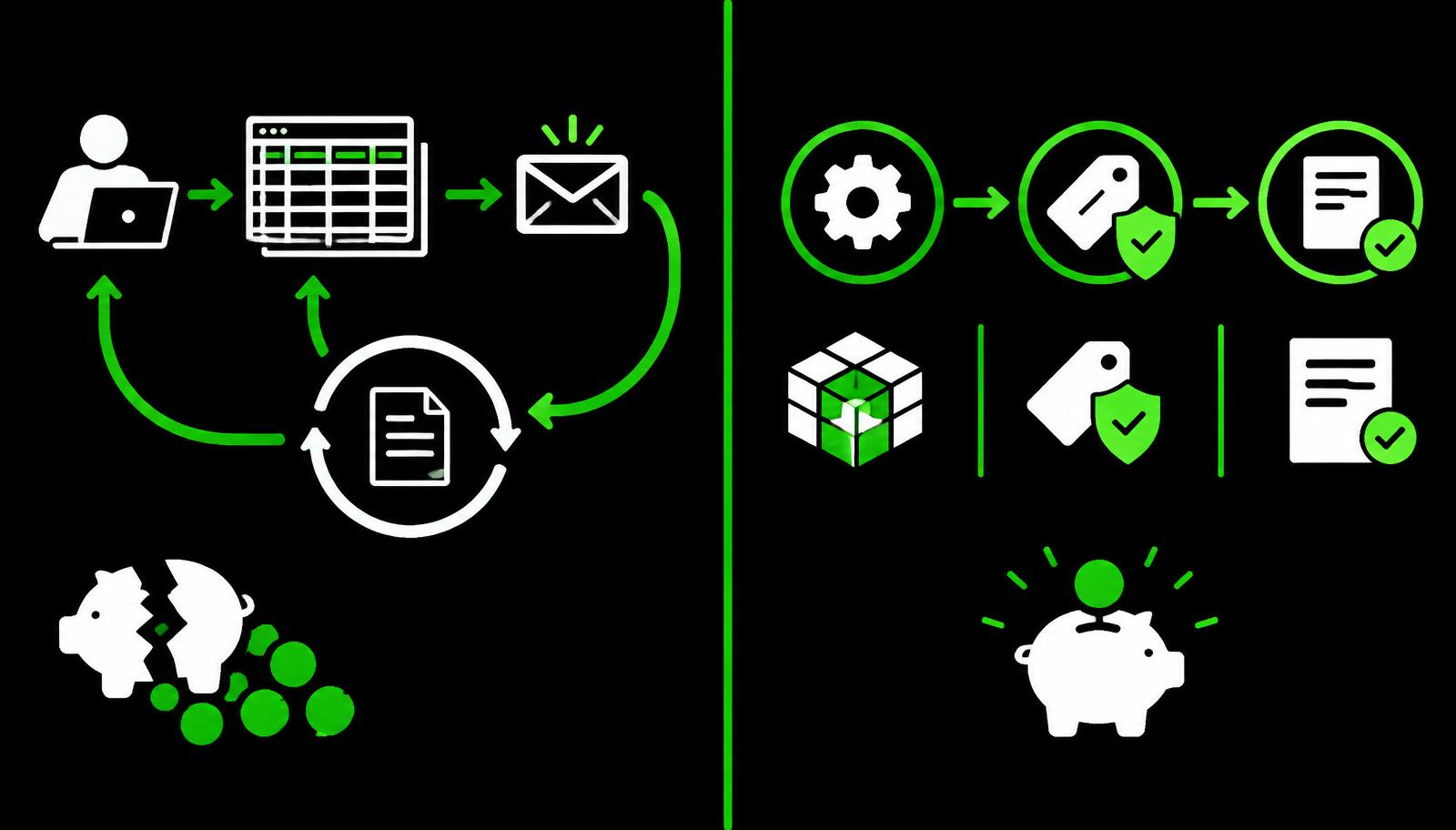
Manual quoting feels free. The reality is that it is one of the most expensive line items in a revenue operation, and almost none of the cost shows up on a dashboard.
A $300M enterprise had 80 sales reps generating quotes manually: spreadsheets, email approvals, Word templates. Leadership assumed the process worked. Finance assumed the margins were clean. RevOps assumed the data was reliable. One quarter, they actually ran the numbers. Average quote turnaround was four days. Average pricing error rate was 11 per cent. Eighteen deals had been lost inside the quoting window. None of it had ever appeared on a report. All of it was costing real money.
Where the process breaks down
Manual quoting looks simple on the surface. A rep builds a quote, a manager approves it, the customer receives it. What is actually happening underneath is a multi-tool, multi-person coordination exercise with no validation, no governance and no single source of truth.
Every manual quote touches at least four systems: CRM, pricing spreadsheet, email and document template. Each handoff is a failure point. Pricing gets applied from an outdated sheet. Discounts get approved over email with no audit trail. Configurations get proposed that cannot actually be delivered. The quote that reaches the customer reflects none of the controls the business thinks are in place.
The problem compounds at scale. One rep making a pricing error is a mistake. Eighty reps working from different versions of the same spreadsheet is a structural breakdown, and it produces results that look like decisions but are actually noise.
Where revenue quietly leaks
The cost of manual quoting shows up in four distinct places. Each one is measurable, and each one is usually understated.
Time cost
Industry data consistently shows sales reps spend 30 to 40 per cent of their time on non-selling activities: quoting, approvals, document formatting. For an 80-rep team at an average OTE of $120K, that is roughly $3.8M in salary spent every year on administrative work. Not selling. Not closing. Building PDFs.
Deal loss
At a four-day quote turnaround, deals go cold. A conservative estimate: if even 10 per cent of pipeline is lost to quoting delays, the prospects who moved on, the budget cycles that closed, the competitors who responded faster, it is a direct revenue hit that never shows up as "lost to quoting" in the CRM. It shows up as "no decision" or silence.
Revenue leakage
Manual discount application without real-time validation means margin erosion at every level. A two to three per cent average discount variance across an 80-rep team on $50M of annual bookings represents $1M to $1.5M of preventable margin loss every year. Invisible. Uncaptured. Recurring.
Rework cost
Every pricing error caught after contract signature creates a rework cycle: legal review, contract amendment, finance reconciliation, customer communication. Each cycle costs hours across multiple teams. At an 11 per cent error rate across hundreds of quotes annually, the downstream operational cost is significant and entirely avoidable.
Manual quoting at scale is not free. It is one of the most expensive hidden costs in a revenue operation.
Why legacy CPQ does not fix it
The obvious answer is CPQ. But not all CPQ solves the problem, and legacy systems often make it worse in different ways.
Tools like BigMachines, early Apttus, Cincom and on-premise SAP quoting modules moved pricing out of spreadsheets and into systems that were equally rigid. Updating a discount tier went from editing a cell to filing a developer change request. Implementation timelines ran nine to eighteen months. Configuration logic got locked inside monolithic architecture that could not be touched without risking everything else.
Companies that invested in legacy CPQ did not eliminate quoting friction. They traded visible spreadsheet chaos for invisible system rigidity. The cost shifted from pricing errors to implementation overhead, maintenance contracts and a sales team that worked around the system rather than inside it.
The comparison is not just CPQ versus manual. It is the right CPQ versus the wrong one.
What good looks like
The real cost comparison is not manual quoting versus any CPQ. It is manual quoting versus a CPQ that actually works, and in 2026 ServiceNow CPQ is where that bar is set.
On ServiceNow, pricing logic is centralised and enforced in real time. Every rep works from the same approved rules: no version control issues, no outdated discount tiers, no configurations that cannot be delivered. Quote turnaround drops from days to under an hour. Margin variance drops because discounts are validated automatically, not applied manually. Error rates drop because the system catches what humans miss.
The financial comparison is direct. Replace $3.8M of quote admin salary cost with rep time spent actually selling. Recover the 10 per cent pipeline loss from quoting delays. Close the $1M to $1.5M margin gap from discount variance. The ROI on modern CPQ is not a projection, it is a recovery of revenue the business is already losing.
AI strengthens every step. It flags undeliverable configurations before the quote goes out. It identifies which pricing structures close fastest. It surfaces margin risk before it becomes a problem. And it does all of this at the speed of a platform, not a spreadsheet.
- For IT leaders, ServiceNow eliminates the integration debt that makes legacy systems so expensive to maintain.
- For finance, it creates an auditable, reliable quoting record that ties cleanly into billing and revenue recognition.
- For sales, it removes the friction that slows every deal down and gives the team back hours that used to go into formatting.
The cost of modern CPQ is known and fixed. The cost of manual quoting is hidden and growing.