
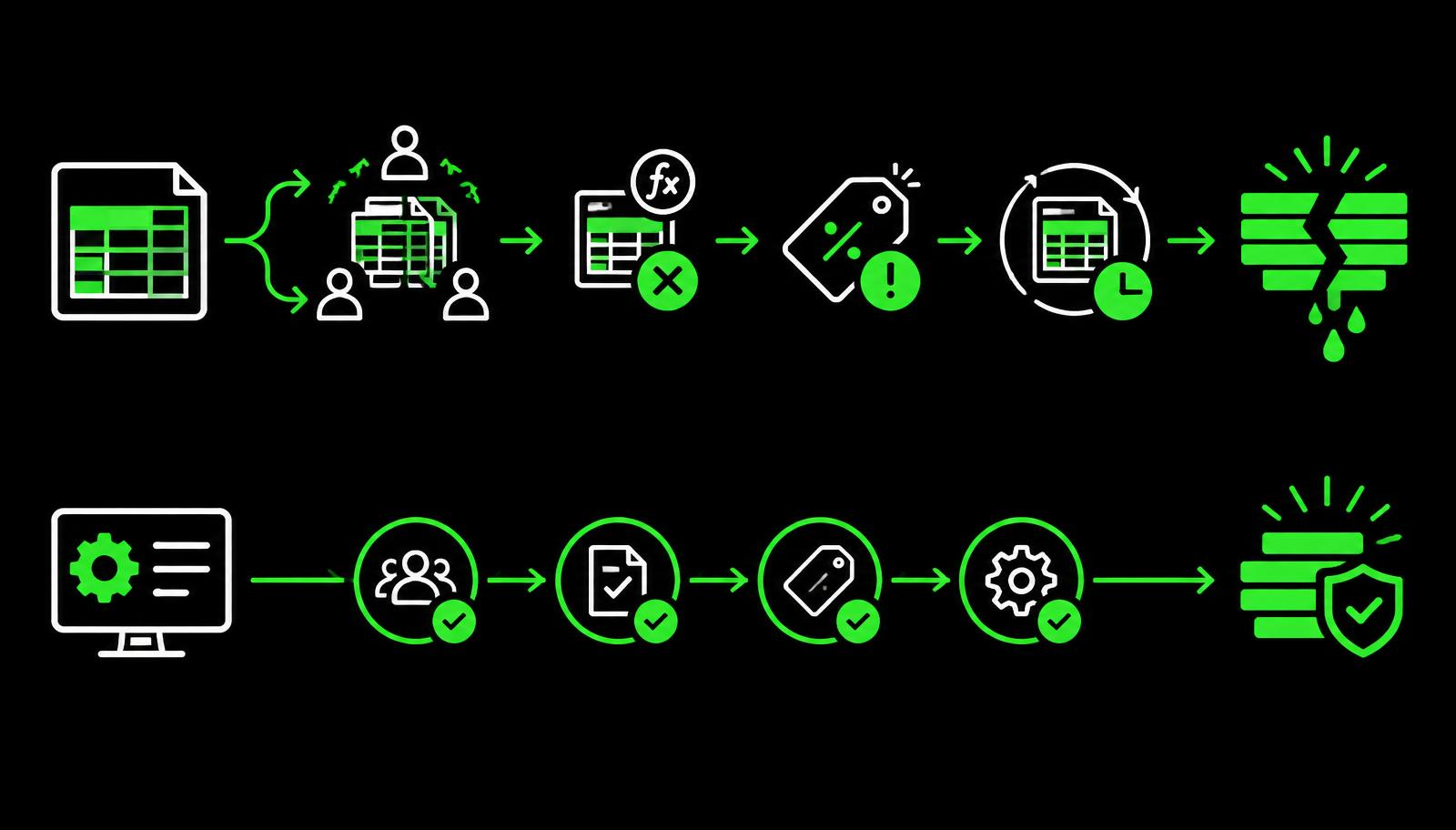
Excel feels free. By the time you can see what it is actually costing you, the spreadsheet is already running your revenue process, and the leakage is already in the numbers.
A B2B SaaS company with $150M in ARR ran its entire quoting process out of one master spreadsheet. Ninety reps. One file. No version control. One quarter, a senior rep sent a Fortune 500 prospect a quote with pricing that had already been updated, but not in her copy of the file. The deal was $2.3M. The error was caught after the contract was signed. That was not a one-off mistake. That was the system working exactly as designed.
Where the process breaks down
Excel was not built to be a quoting infrastructure. It was built for analysis. But in most B2B SaaS companies, it became both, and that is where the trouble starts.
At any given moment, fifteen versions of the pricing sheet live in fifteen different inboxes. When pricing changes, the update reaches some reps and not others. There is no validation layer. No enforcement mechanism. A rep sending an outdated quote has no way of knowing it is outdated.
Pricing spreadsheets also accumulate complexity over time: nested formulas, hidden rows, logic built by someone who left two years ago. One broken cell reference cascades into a pricing error that no one catches until finance reconciles the contract. By then, the quote is already signed.
This is not a training problem. It is structural. Quoting requires governance, validation and control. A spreadsheet cannot provide any of them.
Where revenue quietly leaks
The cost of Excel-based quoting does not appear in a report. It accumulates across four areas.
Revenue delays
Manual quote assembly takes hours. In enterprise SaaS, where procurement windows are tight and buyers run parallel evaluations, a competitor with modern CPQ sends an accurate quote while your rep is still formatting the spreadsheet.
Deal loss
Excel quotes look like Excel quotes: inconsistent formatting, manual calculations, no dynamic pricing. In a competitive deal, presentation is part of the evaluation. A professionally generated quote closes faster than a PDF built from a template.
Revenue leakage
Wrong discount tier. Bundle priced below the approved floor. Custom deal never flagged for approval. In a 90-person sales team, even a two to three per cent discount variance across the book represents millions in margin erosion annually, none of it visible on any dashboard.
Operational drag
Finance reconciles quotes against contracts. RevOps rebuilds reports due to inconsistent deal data. Legal reviews contracts that do not match approved terms. The spreadsheet feels free. The cost of maintaining it is not.
Conservatively, Excel-based quoting costs a $150M ARR business 7 to 12 per cent of addressable revenue every year. It never shows up on a dashboard. That is precisely why it persists.
Why legacy CPQ does not solve it either
Some companies recognise the Excel problem and invest in legacy CPQ tools like BigMachines, early Apttus, Cincom or on-premise SAP quoting modules. They moved pricing out of spreadsheets and locked it inside developer-dependent systems instead.
Updating a discount tier went from editing a cell to filing a change request. Implementations ran nine to eighteen months. By go-live, the product catalogue had changed and the sales team had already built new workarounds.
Companies traded an Excel problem for a rigidity problem. Neither works for a fast-moving SaaS business.
What good looks like
Moving off Excel is not about getting a better tool. It is about connecting quoting to the infrastructure where your revenue operations already run.
ServiceNow CPQ puts pricing logic, approvals, product configuration and contract generation inside one unified platform. When pricing changes, it updates everywhere instantly: no versioning issues, no formula errors, no outdated quotes reaching prospects.
A rep configures a deal, pricing validates in real time, approvals route automatically and the quote goes out, accurate and branded. What took a day takes under an hour.
- AI catches what humans miss. Undeliverable configurations are flagged before the quote goes out, discount levels outside approved margins are surfaced, and the pricing structures that close fastest become visible.
- Quoting connects to billing. Configuration, contract and invoice share the same source of truth, so pricing errors stop arriving at finance.
- Forecasting becomes reliable. Deal data is consistent across reps, so RevOps and finance work from the same numbers.
The spreadsheet feels free until you put a number on the deals, margin and time it has quietly absorbed.