
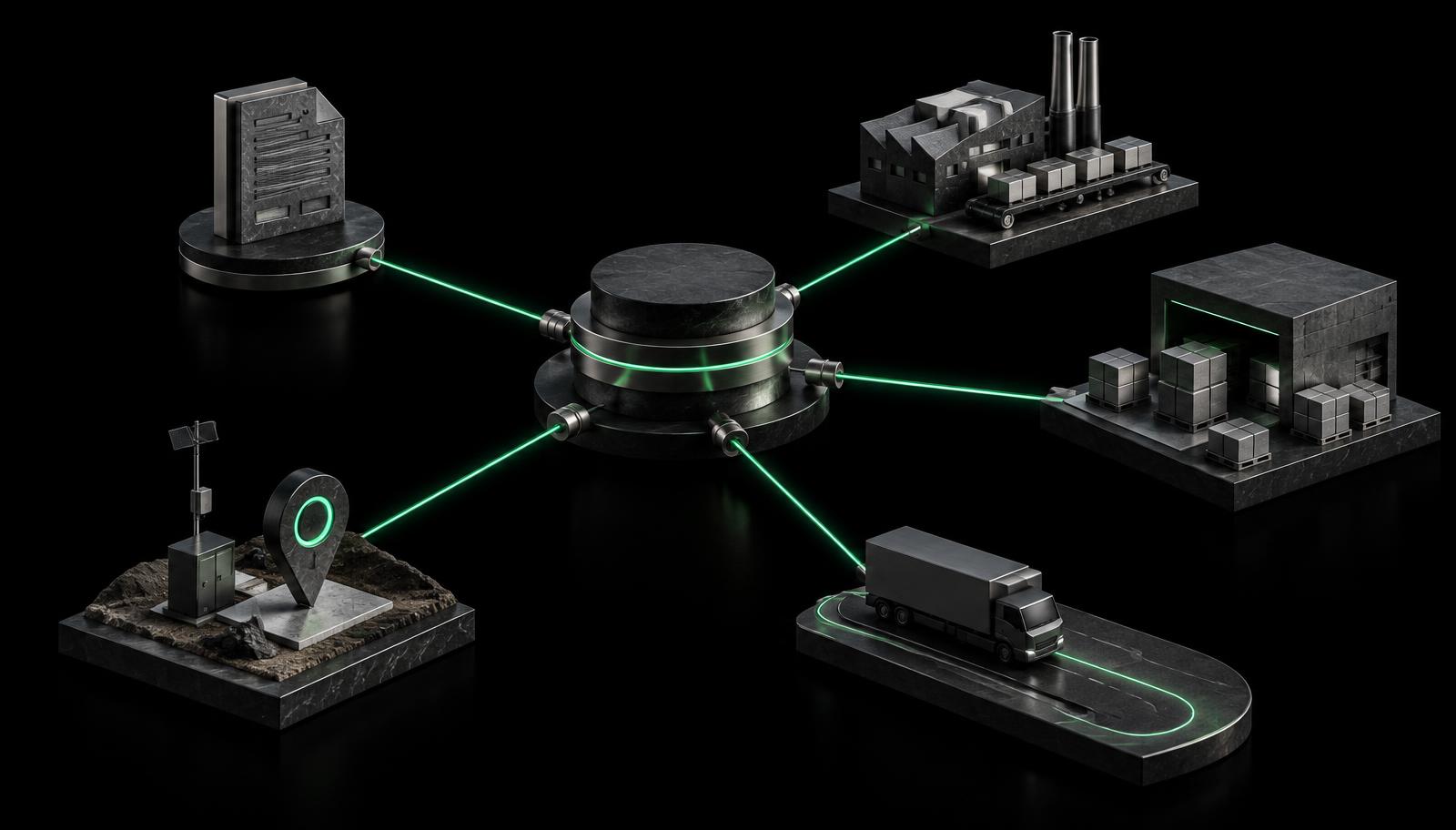
ServiceNow order orchestration coordinates an accepted customer order across the systems and teams responsible for fulfilment. It preserves the commercial intent of the quote, decomposes the order into executable work, tracks dependencies and exceptions, and keeps the order visible from signature to delivery.
Consider an industrial equipment manufacturer that wins a €2.1 million order for twelve packaged units with site installation. Within days, the same order appears as a PDF in CRM, a sales order in ERP, a production request at the plant, a coordinator's spreadsheet and a calendar booking for the site survey. Every system may be working correctly, yet nobody can answer a simple customer question: "Where is my order?"
The missing capability is not another point-to-point integration. It is an orchestration layer that holds the order together while every system and team completes its part.
What is order orchestration in ServiceNow?
Order orchestration is the layer that turns an accepted quote into coordinated work across every system and team involved in delivery. It maintains the order's overall state while production, procurement, logistics, projects and field service complete their respective activities.
It is not the same as ServiceNow CPQ, which helps sales teams configure, price and quote an offer. It is also not the same as ERP, which records line items, stock movements, invoices and the financial status of an order. Orchestration manages the operational journey between the two.
How does ServiceNow order orchestration work?
Three mechanics determine whether order orchestration works in practice.
1. The quote-to-order handoff preserves commercial intent
A quote is a commercial record of what was agreed, at what price and on what terms. An order is executable: it defines what must be built, sourced, shipped, installed or activated. These objects have different purposes, but the transfer between them must preserve product configuration, customer commitments and fulfilment attributes.
If the options selected during configuration do not reach downstream tasks, someone has to reconstruct them from documents or emails. That manual interpretation creates avoidable delays, rework and delivery errors.
2. Decomposition turns one order into coordinated work
One customer order is rarely one piece of work. ServiceNow can decompose it through a hierarchy of orders, line items, domain orders and order tasks. A single signed order can therefore create production requests, procurement actions, logistics bookings, projects and field-service work, each with its own owner and timetable.
Staggered decomposition is useful when later work depends on information that does not yet exist. For example, installation tasks may only become clear after a site survey. Attribute propagation carries relevant configuration choices down the hierarchy so each team receives the context it needs.
3. Fulfilment plans define sequence and dependencies
A fulfilment plan describes how an order should be delivered. Catalogue-driven orchestration lets the product definition determine which tasks are created, their sequence and their dependencies. The orchestration plan then provides visibility at order and line-item level.
This makes a new product configuration a controlled catalogue change rather than a bespoke development exercise. Decision tables can also determine which domain orders create a work order, project or ERP transaction. Routing remains business configuration rather than hard-coded logic.
What is the difference between CPQ, order orchestration and ERP?
| Capability | Primary question | Typical responsibility |
|---|---|---|
| CPQ | What can we sell, at what price and on what terms? | Configuration, pricing, approvals, proposal and quote |
| Order orchestration | How will we deliver what the customer bought? | Decomposition, task coordination, dependencies, status and exceptions |
| ERP | How is the order recorded financially and logistically? | Sales order, inventory, procurement, invoicing and accounting |
The systems are complementary. CPQ should pass accurate commercial intent into orchestration. Orchestration should coordinate the operational work without trying to replace specialist execution systems. ERP should remain the financial and transactional system of record.
Why do legacy quote-to-order processes struggle?
Traditional CPQ often finishes when the customer signs. ERP begins with the resulting order, but models it primarily as a financial and logistical transaction. The operational space between signature and completion is then filled by email, spreadsheets and experienced coordinators.
Point-to-point integrations do not automatically solve this problem. Each system still holds only its own fragment of the order, and adding another platform introduces another set of connections and failure behaviours. Five systems can each provide a correct status without any one of them showing the complete customer order.
What does poor order orchestration cost?
Revenue and cash arrive later
For many manufacturers, revenue is recognised on delivery or acceptance rather than signature. Every avoidable delay between systems can push recognised revenue and cash collection into a later period.
Delivery dates become unreliable
If a committed date depends on somebody phoning the plant or checking several systems, sales must either add excessive contingency or make a promise without reliable operational evidence. Both weaken customer confidence.
Sales stops trusting the process
When salespeople see configured orders fail downstream, they begin checking every quote informally with operations. A systematic process becomes relationship-dependent, and skilled sales staff spend time chasing internal answers instead of customers.
Coordination cost grows with order volume
When people manually coordinate every order, operational cost rises with volume. The business also loses a reliable audit trail and a credible view of delivery capacity, blocked work and forecast completion.
What should a modern orchestration architecture look like?
The orchestration layer should sit above execution systems rather than replace them. Manufacturing systems should continue to run production, warehouse systems should manage stock, ERP should manage transactions, and ServiceNow FSM should manage field execution. ServiceNow holds the customer order as one connected object while those systems perform their specialised work.
Reusable integrations are preferable to bespoke connections. The orchestration logic should remain separate from the connector used to reach an ERP or fulfilment platform, reducing the impact of future system changes.
Why are exceptions the real test of order orchestration?
Most programmes design the happy path first and treat failure as an edge case. Real orders change after submission: parts become unavailable, dates slip, customers request amendments and downstream systems reject transactions.
A credible design gives exceptions their own workflows and ownership. Fallout management helps teams investigate failed activities. Jeopardy management compares planned and committed dates so risk can be escalated before the customer commitment is missed. In-flight change, suspension, resumption and manual task creation let operations respond without abandoning the governed process.
AI can add practical value by predicting likely fallout, classifying exceptions by probable cause and identifying orders whose dates are quietly slipping. It should improve prioritisation and intervention, not disguise weak process design.
How should enterprises implement ServiceNow order orchestration?
- Map the promise. Identify which quote attributes, terms and dates must survive into fulfilment.
- Define the order model. Agree how customer orders, line items, domain orders and tasks represent the work.
- Design decomposition. Decide which work starts immediately, which waits for new information and which system owns each activity.
- Configure routing. Use decision tables and fulfilment plans for rules that the business needs to change.
- Design failure first. Test rejected transactions, unavailable stock, changed dates and customer amendments before go-live.
- Measure customer outcomes. Track fulfilment cycle time, fallout, jeopardy, manual touches and commitment accuracy.
The goal is not to put every fulfilment activity inside ServiceNow. It is to give the enterprise one governed view of the order, its dependencies and its customer commitment across the systems already doing the work.
Frequently asked questions
Is order orchestration part of ServiceNow Sales and Order Management?
Yes. ServiceNow Sales and Order Management brings customer orders, decomposition, fulfilment plans, tasks, status and exception handling onto the Now Platform while integrating with systems such as CPQ and ERP.
Does order orchestration replace ERP?
No. ERP remains responsible for core financial and transactional processes. Order orchestration coordinates work across ERP and other execution systems while maintaining an end-to-end operational view of the customer order.
Does ServiceNow CPQ include order fulfilment?
CPQ focuses on configuring, pricing and quoting the offer. Order fulfilment starts after acceptance. The two should be connected so product configuration, commercial terms and customer commitments pass accurately into orchestration.
What is order decomposition?
Order decomposition breaks one customer order into the domain orders and tasks required to fulfil it. Those activities can be routed to production, procurement, logistics, projects, field service or other specialist teams and systems.
What is fallout management in order orchestration?
Fallout management identifies and governs fulfilment activities that fail or cannot proceed. It gives the exception an owner, status and resolution workflow instead of leaving a transaction stuck without visibility.
What should businesses measure after implementation?
Useful measures include quote-to-order handoff accuracy, order fulfilment cycle time, manual touches, fallout rate, time to resolve exceptions, jeopardised commitments and on-time delivery or activation.