
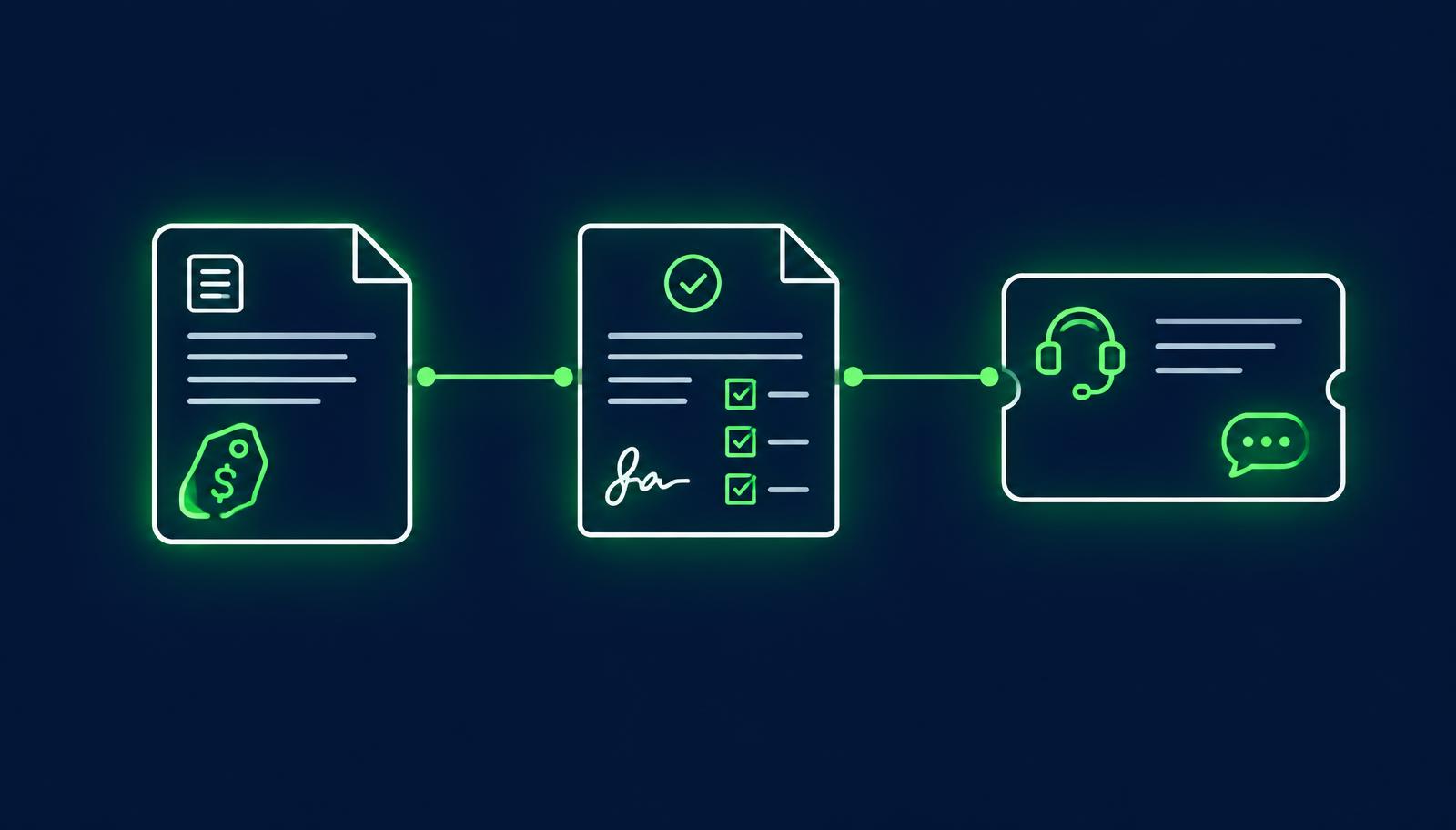
A quote is a proposal, an order is a commitment and a case is a request for help. They feel adjacent because a customer experiences them as one continuous relationship, but inside ServiceNow they are three different object types with different owners, lifecycles and obligations, and confusing them is the most expensive early design mistake in a CRM implementation.
A telecom operator went live with ServiceNow CSM and Order Management on the same programme. Eight months later, their "average case resolution time" was 34 days and climbing, and the CSM dashboard was meaningless to everyone who looked at it.
The cause was a design decision made in week three of the build. A solution architect, reasoning that fulfilment work needed tracking and cases were already tracked, modelled every customer order as a case with a custom order_type field and child cases for each fulfilment step. It worked in the demo. In production, service SLAs were firing on manufacturing lead times, agents were being paged about shipments they could not influence, and finance could not tie a single delivery to a revenue milestone because the milestone lived in a case field with no contractual meaning.
Rebuilding it cost fourteen weeks and a rewrite of every report. Nothing had been broken. The objects had simply been used for the wrong thing.
What is actually going wrong?
Quotes, orders and cases feel adjacent because a customer experiences them as one continuous relationship. Inside the platform they are three genuinely different object types, with different owners, different lifecycles, different obligations and, importantly in ServiceNow, different structural foundations.
A quote is a proposal
A quote is a priced, configured, time-bounded offer. It says: this is what we would sell you, at this price, under these terms, if you accept by this date. It carries no obligation to deliver on either side.
Structurally, a quote is a header with quote line items, each holding a configured product offering, quantity, term, pricing and discount. Its defining characteristics are versioning and expiry. Quotes are negotiated, so v1 through v7 are normal and all of them matter for audit. Approval routing is a first-class concern because discounting authority is a control. A quote is typically parented to an opportunity and owned by sales.
The critical property: a quote is mutable until it is accepted, and inert after. Nothing downstream should ever read a quote as the source of truth for what the business owes a customer.
An order is a commitment
An order is the record of what was actually agreed. It is the commercial contract in operational form: line items, actions, terms, dates, the account, the sites. Its purpose is not negotiation; it is execution and evidence.
An order carries order line items that specify not only what but what change: add, modify, disconnect, suspend or resume, against the customer's installed base. That action type is what makes an order fundamentally different from a quote. A quote line says "a 200 Mbps circuit at €X". An order line says "add a 200 Mbps circuit at this site, replacing the existing 100 Mbps circuit, effective on this date". The second is an instruction; the first is a price.
The order is the input to decomposition and orchestration: it is broken down into the fulfilment tasks required to deliver it, across provisioning, logistics, field service and billing. The order owns the delivery commitment, the milestones that gate revenue recognition, and the amendment history. Change is handled through change orders that patch a live plan, not through editing the original record.
A case is a request for help
A case is a record of a customer issue or request requiring resolution by a service team. Something is wrong, unclear or needed, and a human or automation must resolve it.
Cases have the properties of service work: assignment groups, SLAs measured in hours, escalation paths, resolution codes, knowledge article linkage, reopen behaviour and customer satisfaction measurement. They are unpredictable in volume, short-lived relative to fulfilment, and their quality metric is time to resolution.
Crucially, a case in ServiceNow extends the Task table. It inherits assignment, state, SLA and work notes semantics because that is what it is: a unit of work assigned to somebody. Quotes and orders are commercial records and do not extend Task. Their fulfilment tasks do, but they themselves do not.
That distinction is the whole design, expressed in the data model.
Where do implementations go wrong?
The commonest early-implementation mistake is collapsing two of these into one, almost always by overloading the case.
The reasoning is always the same and always sounds sensible: cases already have assignment, SLA, state and a portal view, so why build anything else? Teams then use cases as fulfilment containers, as order-status trackers, or as quote-request records with custom fields bolted on.
Four things break, predictably.
SLA semantics become nonsense. A case SLA answers "how long did we take to help this customer?" A fulfilment duration answers "how long did it take to build and deliver this?" Mixing them destroys both measures. Resolution time inflates to weeks, breach reporting becomes noise, and agents stop trusting the queue.
Decomposition is impossible. Cases have no line items and no action types. There is nothing to decompose, so the task graph has to be hand-built as child cases with hard-coded parenting. The dependency logic ends up in business rules rather than in a fulfilment plan, and in-flight amendment becomes cancel-and-rebook.
The installed base breaks. Orders update the customer's installed base; that is one of their core jobs. A case does not, so the installed base drifts from reality. Every future order that needs to know what the customer already has is now working from bad data. This compounds silently and is expensive to unwind.
Commercial traceability disappears. Revenue milestones, contract terms and billing triggers have no defensible home on a case. Finance ends up reconciling manually, and audit has no clean chain from what was quoted, to what was ordered, to what was delivered.
The inverse mistake appears too, less often but just as damaging: raising orders for things that are not commercial commitments. A customer calling about a faulty router does not need an order; that is a case, which may generate a replacement order as an output. Modelling the complaint as an order pollutes order volume metrics and makes fulfilment throughput unreadable.
A third variant: treating quotes as orders. Teams push the accepted quote straight into fulfilment without creating an order, on the grounds that the data is identical. It is not identical. The quote has no action types, no installed-base linkage, no amendment model and no milestone structure. And the moment a quote is amended after fulfilment begins, the record of what was actually promised is gone.
The relationships that should exist
The correct pattern is reference, not containment.
A quote converts to an order, and is frozen at that point. The order references the originating quote for commercial traceability. A case may reference an order ("my order is late", "the installed unit is faulty") and may generate a new order as a remedy, such as a replacement or an expedited dispatch. An order should never be a case, and a case should never carry line items.
What is the business impact?
This looks like an architecture argument. It lands as a commercial one.
Reporting becomes unusable, so decisions stop being data-driven. When fulfilment work sits inside case volume, no one can answer basic questions: how many orders are in flight, what is the true order-to-cash cycle, where is the bottleneck. Leadership reverts to anecdote and escalation.
Revenue recognition slips. If the commissioning or acceptance evidence lives in a case field rather than on an order milestone, finance chases it manually. On complex orders that is days to weeks of slippage per deal, concentrated at quarter end where it does the most damage to forecast credibility.
Service costs rise. Agents get assigned work they cannot perform. A service rep cannot expedite a production line. Every fulfilment step routed into a service queue is a handoff, a wait, and a customer update that adds no progress. Handle time goes up while resolution stays flat.
Deals get quoted badly. Without a clean order history, there is no reliable data on how long anything actually takes to deliver. Reps commit dates from optimism, miss them, and the next tender is scored on that record.
Remediation is expensive and late. The mistake is invisible during build and obvious in production. By then there is live data in the wrong shape, integrations bound to the wrong tables, and reports everyone depends on. Migration projects of three to six months are typical, and they consume roadmap capacity that was promised to new capability.
Why does legacy CPQ struggle here?
This confusion is inherited, not invented. Legacy CPQ stacks never had clean object separation to begin with.
In the Salesforce and Oracle quoting generations, the quote is the centre of gravity and the order is frequently a thin derivative: a closed opportunity, a synced record, or a flag. There is no first-class order object that owns actions, milestones and amendment history, because fulfilment was out of scope by design. When customers need one, the answer is a custom object, which means custom lifecycle, custom reporting and custom everything else.
Cases, meanwhile, arrive from the support side of the platform as a deliberately generic container. Generic containers attract work. Because a case can be extended with any field and any state, it becomes the path of least resistance for anything that needs tracking. The platform does not resist, so the design drifts.
Two structural consequences follow.
No shared product model across the lifecycle. The quote's product structure and the fulfilment system's product structure are different models, reconciled by integration mapping. Because the mapping is lossy, teams compensate with custom fields on whatever object is nearest, which is how commercial data ends up on service records.
No amendment model. Legacy stacks treat orders as records rather than running processes. There is no concept of patching a partially executed commitment, so in-flight change is handled by cancelling and re-entering. Teams then invent a parallel tracking mechanism for "the change we are actually making", and that mechanism is, again, usually a case.
Both are architectural. No amount of configuration closes them, which is why these implementations tend to fail the same way regardless of the integrator.
What does the modern approach look like?
The correction is not complicated, but it has to be made early, because every week of build after the decision increases the cost of reversing it.
Let each object own one obligation. The quote owns the offer and its negotiation history. The order owns the commitment, the actions against installed base, the delivery milestones and the amendment chain. The case owns the resolution of an issue and its service-level performance. If a requirement does not fit an object's obligation, that is a signal to create the right record, not to add a field.
Use the Task hierarchy deliberately. Things that are assigned to someone and worked to completion belong on Task. Commercial commitments do not. Fulfilment tasks generated by decomposition sit under Task and inherit assignment and SLA properly. The order above them does not, and should not.
Make relationships explicit and directional. Quote references opportunity. Order references quote. Case references order. Case may create order. Nothing is nested inside something of a different type. This single rule prevents most of the drift.
Model the installed base from the start. It is what makes an order line an instruction rather than a price. Skipping it is the most common reason teams later find they cannot tell an "add" from a "change", and it is nearly impossible to retrofit accurately once live data exists.
Test the design with amendment and complaint. Two questions expose a broken model quickly: can a customer change this order in week two without it being cancelled, and can a customer complain about this order without the complaint becoming part of the order's own workflow? If either answer is no, the objects are conflated.
AI-assisted CPQ is starting to help at the seams here, mostly by routing intent correctly: classifying an inbound request as a quote request, an order amendment or a service issue before a human picks the wrong record type, and flagging when a case has been open long enough that it is probably fulfilment work misfiled. That only works if the underlying objects are clean. Classification into a muddled model just produces confident mislabelling.
Frequently asked questions
Can a case ever contain order line items?
No. A case may reference an order and may generate one as a remedy, but line items, action types and milestones belong on the order. Putting them on a case breaks decomposition, installed-base updates and commercial traceability.
Why not push the accepted quote straight into fulfilment?
A quote has no action types, no installed-base linkage, no amendment model and no milestone structure. The order is the record of what was actually agreed; skipping it means the first in-flight change erases the record of what was promised.
How do you test whether the objects are conflated?
Ask two questions: can a customer amend this order in week two without it being cancelled, and can a customer complain about this order without the complaint joining the order's workflow? A "no" to either means the objects are conflated.
Where does ServiceNow fit?
ServiceNow keeps the three objects separate by design: quotes and orders are commercial records in Sales and Order Management, while cases extend the Task table in Customer Service Management. Fulfilment tasks generated by decomposition sit under Task, so each object owns exactly one obligation.