
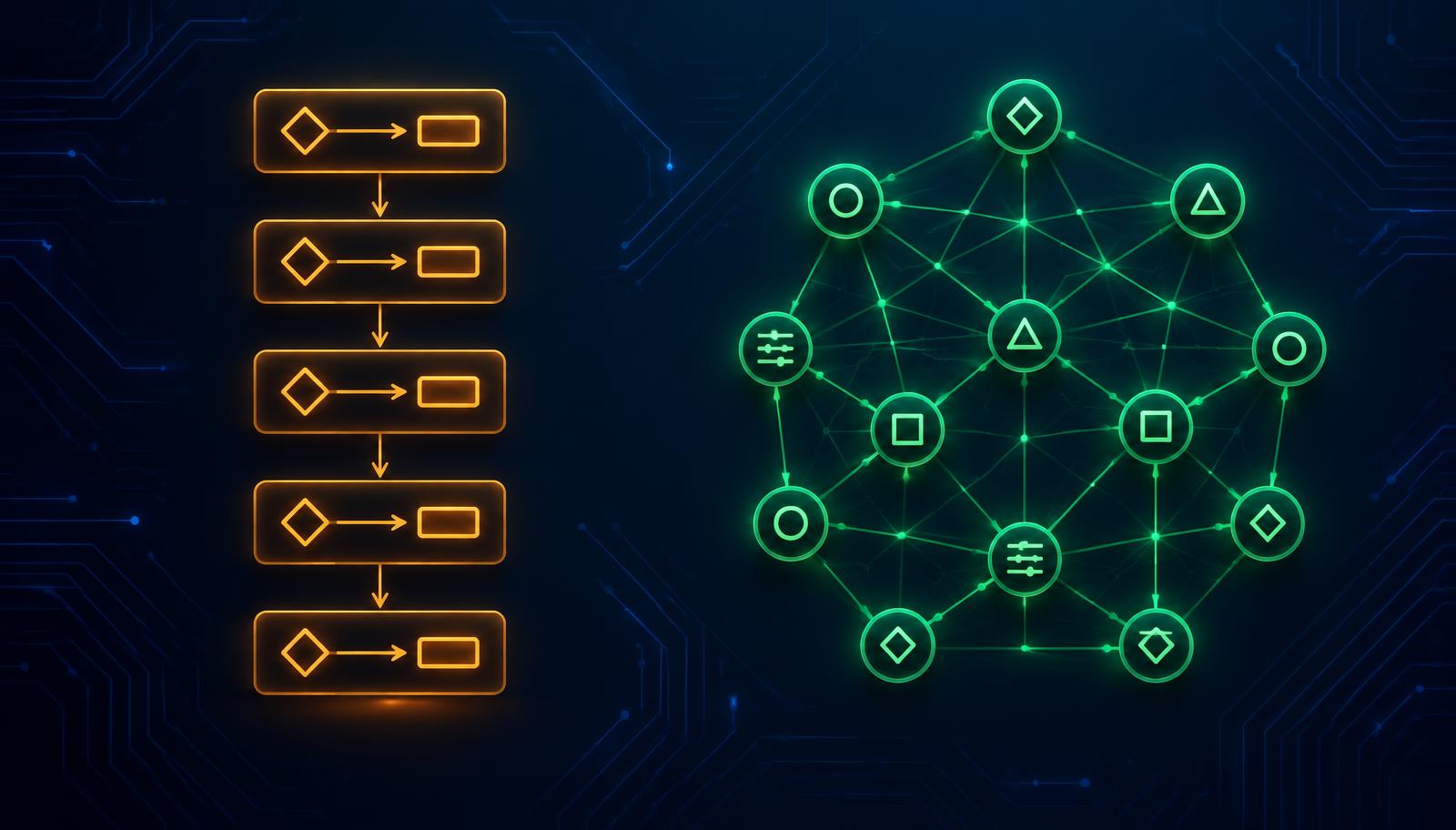
A capital equipment manufacturer's CPQ configurator had 340 configuration rules by the time it reached year three. Adding a new attribute to the product line, a routine catalogue change, now took a senior consultant two weeks, because every new rule had to be checked against the firing order of every existing one to make sure it was not evaluated too early or too late.
The team had built the rules in the natural order requirements arrived: "if voltage = 480V then require phase = 3" went in during month one; "if region = EU then restrict voltage options" went in during month eight; "if phase = 3 and region = EU then hide the single-phase warranty option" went in during month nineteen, because nobody had anticipated that combination existing. Each rule worked in isolation. Together, the firing sequence mattered enormously, and nobody had documented it. A configuration that had validated correctly for two years suddenly started producing invalid quotes after a routine rule was reordered during an unrelated change, and it took eleven days to find out why.
This was not a rule-writing problem. It was an architectural ceiling the team had reached without realising a ceiling existed.
What is actually going wrong
There are two fundamentally different ways a configurator can decide whether a configuration is valid, and the difference is not stylistic. It is architectural, and it determines whether the system scales.
Rules-based (sequential) configuration
In a rules-based or sequential rule engine, validity is enforced by a series of discrete if-then statements, each one evaluated in a defined order against the current state of the configuration. When an attribute value changes, the engine walks through the applicable rules in sequence, applying each one's consequence (showing or hiding an option, setting a default, restricting a domain, raising a validation error) before moving to the next.
This is procedural logic. Rule 12 runs before rule 13 because someone set it that way, and rule 13's correctness depends on rule 12 having already run. This is exactly the pattern ServiceNow's CPQ Configurator implements through its unified rules framework: configuration rules attached to blueprints, evaluated to enforce visibility, defaults, validation and calculations as the buyer or agent moves through the configuration.
For a bounded catalogue, this is a completely reasonable design, and it is the design the overwhelming majority of CPQ implementations use, including most production ServiceNow builds. It is transparent: a rule reads like a sentence, an admin can open it and understand exactly what it does without special training. It is incremental: a single new requirement usually means writing a single new rule. And it requires no specialised expertise, since a product analyst or catalogue admin, not a constraint-programming specialist, can build and maintain it through a no-code rule designer.
The cost is what happens as the rule count grows. Because each rule's correctness can depend on execution order, and because a new rule can interact with any existing rule whose consequence touches the same attribute, the number of potential interactions between rules grows roughly quadratically with the number of rules, not linearly. Two hundred rules do not create twice the maintenance burden of one hundred; they create something closer to four times the burden, because every new rule has to be checked against a much larger set of prior rules for order-dependent conflicts. This is the exact mechanism behind the opening scenario, and it is a well-documented failure pattern across sequential-rule CPQ platforms generally, not something specific to any one vendor.
Constraint-based configuration
In a constraint-based system, validity is not defined by an ordered sequence of instructions. It is defined by a declarative set of constraints, logical statements about which attribute values and part combinations are jointly permissible, that together describe the entire space of valid configurations. A configuration solver evaluates the complete constraint set simultaneously against the current selections, rather than firing rules one at a time in a fixed order, to determine what remains valid, what is now required, and what has become excluded.
A rules engine tells the system what to do in response to an event, in a sequence someone defined. A constraint engine tells the system what is true, and lets the solver derive the consequences, in any order.
This is the same underlying principle behind constraint-satisfaction techniques used in scheduling and logic programming for decades, applied to product configuration.
Because constraint definitions do not depend on firing order, adding a new constraint does not require auditing the priority of every existing one. It also enables something sequential engines fundamentally cannot: proactive filtering. A constraint-based configurator can compute, before the buyer makes a selection, which upcoming options are still reachable given everything already chosen, greying out or removing choices that would lead to an invalid end state, rather than letting the buyer pick something and then telling them afterwards that it conflicts with an earlier choice. This is the difference between a configurator that prevents invalid states and one that detects them after the fact.
Why this is the scalability decision, not a style preference
The architectural consequence compounds specifically with catalogue size and interconnectedness, along three dimensions.
Maintenance complexity. In a sequential system, every new rule is a new candidate for an ordering conflict with every rule that touches an overlapping attribute. In a constraint system, a new constraint is added to the set and the solver's evaluation logic does not need to be told where in a sequence it belongs, because there is no sequence. The maintenance burden of a constraint-based catalogue grows roughly linearly with catalogue complexity; the maintenance burden of a large sequential rule set grows faster than that.
Determinism under change. A sequential engine's output for a given input can change if two rules are reordered, even though neither rule's own logic changed, as the opening scenario demonstrates. A constraint set's output is a function of the constraints themselves, not their storage order, so reordering how constraints are entered or displayed has no effect on evaluation.
Where the processing time goes. In a large sequential system, a nontrivial share of processing is spent determining which rules should fire and in what order, not evaluating the business logic itself. As rule counts climb into the hundreds, this overhead becomes a real performance factor, not just a maintenance one. A constraint solver spends its cycles solving the constraint set, not sequencing it.
None of this makes rules-based configuration wrong. It makes it a design with a known ceiling, and the honest architectural question is whether a given catalogue is going to approach that ceiling.
Being fair to rules-based configuration
It is a mistake, common among vendors selling constraint engines, to present rules-based configuration as simply the inferior, legacy option. For a large share of real catalogues, it is the correct choice, for reasons that matter in practice.
Simple, shallow catalogues do not hit the scaling wall. If a product line has a handful of attributes with limited interdependency, say a service tier, a term length, and a support level, with perhaps a dozen total rules, sequential rules are easy to write, easy to read, and easy to hand off to a junior admin. The quadratic-interaction problem is a function of rule count and overlap density, not a property of rules-based systems in the abstract. Two hundred rules on tightly coupled attributes is a real problem. Twenty rules on a simple product is not, regardless of engine architecture.
Transparency has real operational value. A sequential rule reads procedurally: "if X then Y." A support engineer debugging why a specific quote configured incorrectly can often trace the exact rule that fired. A constraint solver's output is mathematically correct but frequently harder to explain to a non-technical stakeholder in a single sentence, since the answer to "why is this option unavailable" may be an interaction across several constraints rather than one traceable rule. For organisations whose product complexity is genuinely low, that traceability is worth more than the theoretical scalability headroom they will never need.
Lower barrier to build and staff. Rules-based tools, including ServiceNow's no-code rule designer, are built to be usable by catalogue and product admins without specialised training. Constraint modelling, done well, benefits from someone who understands how to model a problem declaratively, a different skill, and a scarcer one, than writing an if-then statement. For a smaller organisation without that skill on staff, a well-scoped rules-based catalogue is a legitimately better operational fit than a constraint engine nobody can maintain confidently.
Migration cost is real and not always worth paying. Moving an established sequential catalogue to a constraint-based model is a genuine re-architecture, not a settings change. For a catalogue that is not experiencing the symptoms of scale, that cost has no offsetting benefit yet.
Business impact
The cost of choosing the wrong architecture for a given catalogue's complexity shows up in predictable places.
- Change velocity degrades on complex catalogues. When a rules-based system outgrows its comfortable range, every new product attribute or option requires disproportionately more time to add safely, because of ordering-conflict risk. Launch timelines slip in a way that scales with catalogue age and size, not with the actual complexity of the individual change being made.
- Invalid configurations reach the customer. A sequential engine that validates after a selection, rather than filtering proactively, allows a buyer to walk into a dead end, a combination that looked available at each step but turns out to be invalid at submission. This produces re-quotes, escalations, and in self-service commerce, abandoned carts.
- Debugging cost rises non-linearly with rule count. An ordering conflict discovered in production, as in the opening scenario, is expensive specifically because the failure mode is subtle: individually correct rules producing a collectively wrong outcome, with no single broken component to point to.
- Overbuilding is also a real cost. An organisation with a simple, stable catalogue that adopts constraint-based tooling anyway pays for solver expertise and a heavier implementation it does not need, with no meaningful gain in outcome quality.
Why legacy CPQ struggles here
Most legacy CPQ platforms, including the majority of production ServiceNow CPQ implementations, are built on sequential rule engines as the default, and for the reasons above, that default is often correct at launch. The struggle is not that sequential engines are used; it is that the architecture is rarely revisited as the catalogue grows, because nothing forces the question. There is no single moment where a rule count crosses a line and a warning appears. The degradation is gradual, each individual rule addition looks reasonable in isolation, and the compounding cost only becomes visible in hindsight, usually as a production incident, as in the opening scenario, rather than as a planning decision anyone made deliberately.
A second structural issue is that few platforms make it easy to run rules-based and constraint-based approaches selectively, by product line, within the same catalogue. The decision tends to get made once, for the whole implementation, rather than per product family based on that family's actual complexity, which is the level at which the decision should really be made.
The modern approach
The practical answer is not "migrate everything to constraint-based." It is matching engine architecture to catalogue shape, deliberately and per product line, and instrumenting rule count and interaction density so the decision gets revisited before it becomes a production incident rather than after.
For shallow, stable product families, a well-organised sequential rule set, kept small, grouped logically, and reviewed periodically for overlap, remains the right, lower-cost choice. For deeply interconnected, high-attribute-count product lines, particularly ones with regional variation, compatibility matrices, or frequent new-option launches, a constraint-based approach avoids the compounding maintenance cost that sequential engines exhibit at that scale, and its proactive filtering materially improves the buyer's guided-selling experience. AI-assisted tooling is starting to help at the margin here too, by analysing an existing sequential rule set for hidden ordering conflicts before they reach production, and by flagging when a catalogue's rule-interaction density has crossed the point where a constraint-based redesign would pay for itself.
Frequently asked questions
What is the difference between rules-based and constraint-based configuration?
A rules-based engine enforces validity through ordered if-then statements, so correctness can depend on the sequence in which rules fire. A constraint-based engine declares which combinations are permissible and lets a solver evaluate the whole set simultaneously, so the result does not depend on entry order.
When does a rules-based configurator stop scaling?
There is no fixed rule count, but the warning signs are consistent: adding an attribute takes days or weeks because of ordering-conflict checks, valid configurations start producing invalid quotes after unrelated changes, and debugging requires tracing firing order rather than reading a single rule. These symptoms track rule count and overlap density, not catalogue revenue or company size.
Is constraint-based configuration always the better choice?
No. For simple, shallow catalogues with limited interdependency, sequential rules are transparent, cheap to build and easy to maintain without specialised skills. Constraint modelling pays for itself only once attribute count and interdependency make ordering conflicts a recurring operational cost.
How does ServiceNow CPQ handle configuration rules?
ServiceNow's CPQ Configurator uses a unified rules framework in which configuration rules attached to blueprints are evaluated to enforce visibility, defaults, validation and calculations as the buyer or agent moves through the configuration, a sequential, rules-based pattern that suits the bounded catalogues most implementations start with.
Summary
The choice between rules-based and constraint-based configuration is an architectural decision with a known failure curve, not a matter of vendor preference. Rules-based engines are the correct default for bounded, shallow catalogues; constraint-based engines earn their cost once attribute count and interdependency make ordering conflicts a recurring tax on every catalogue change.
The organisations that get this right do not pick one engine for the whole estate and forget the question. They match the engine to each product family's actual complexity, instrument rule count and interaction density, and revisit the decision on evidence rather than on the day a production incident forces it.