
Selling complex products has always been harder than it sounds. Once a company moves beyond simple catalogue items into configurable equipment, tiered services or engineered-to-order solutions, the sales process becomes a maze of spreadsheets, PDF price books and knowledge held by a handful of senior sales engineers.
Buyers, meanwhile, expect the kind of easy, self-service experience they get as consumers, even when they are buying a six-figure industrial system. Guided selling is how the CPQ market has answered that gap. Rather than asking someone to pick a SKU from a list, it leads them through a needs-based conversation and lets the system translate the answers into a valid, priced and compliant configuration. The expertise moves from the person to the software.
The problem guided selling solves
Traditional CPQ tools were built mainly as quoting systems: digital versions of the price book. A rep, or a buyer in a self-service scenario, had to know roughly what they wanted, a product family, model number or SKU, before the system could help. That works for simple, discrete products. It falls apart with real complexity: multi-level bills of materials, thousands of compatible and incompatible component combinations, regional pricing rules and configuration logic that changes with how the product will be used.
ServiceNow has described the result plainly: sales teams lose time navigating spreadsheets, outdated pricing models and disconnected approval workflows, which delays deals and frustrates customers. Buyers feel the same pain from the other side. They face a wall of SKUs and specification sheets and are expected to know which combination meets their requirements, satisfies engineering constraints and stays within budget.
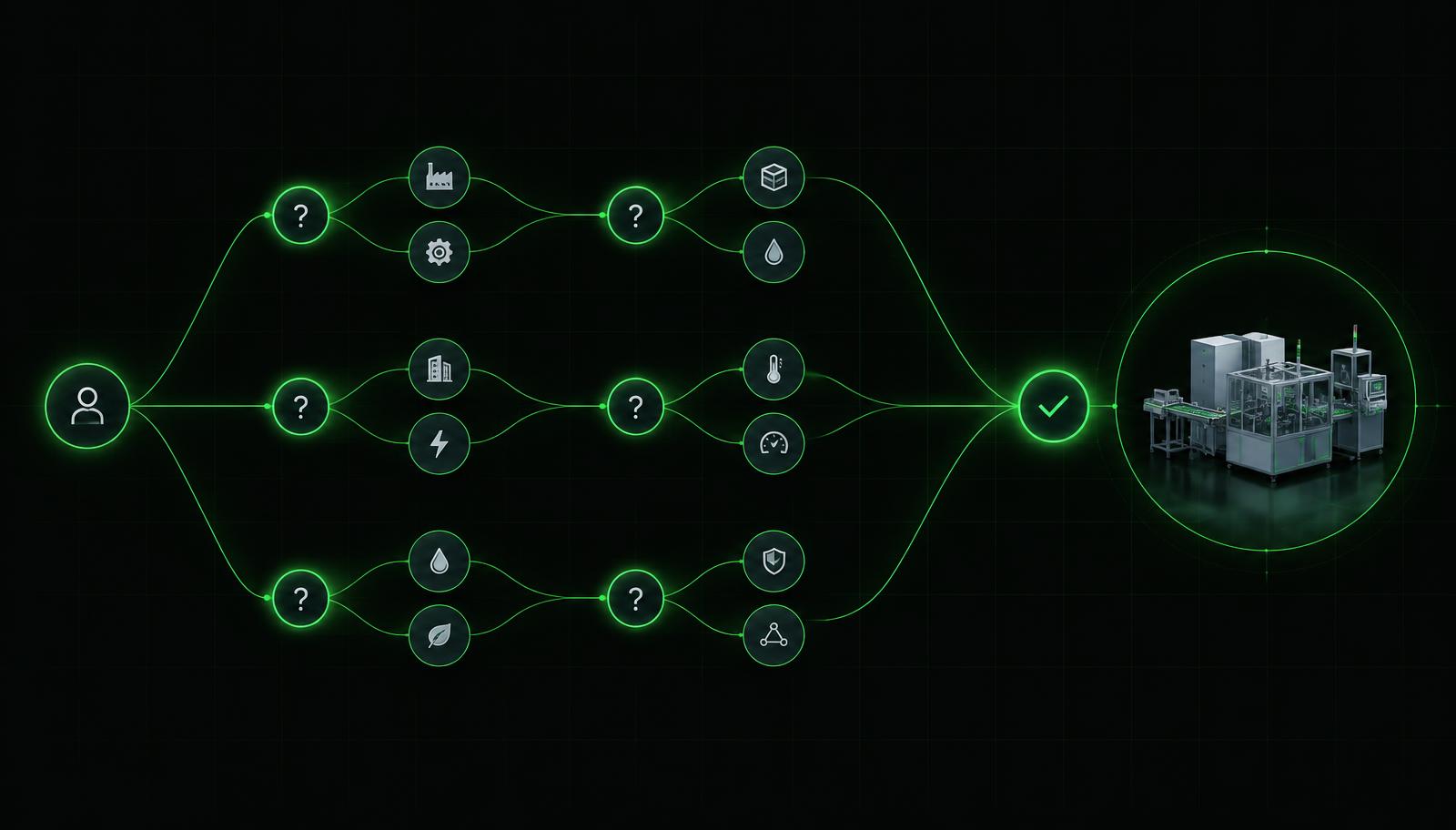
Guided selling reframes the interaction. Instead of "here is our catalogue, go and find what you need", the system asks what problem you are solving, what environment the product will operate in and what your budget or use case is. It then uses the answers to assemble a solution, not just a product.
Background: Logik.ai and ServiceNow CPQ
Logik.ai (originally Logik.io) built its reputation as an independent, AI-assisted configuration and CPQ engine, often used to give platforms such as Salesforce a faster, more flexible rules engine for complex products. In April 2025 ServiceNow announced a definitive agreement to acquire Logik.ai, positioning it as a composable CPQ capability to extend its CRM portfolio.
The strategic logic was simple. ServiceNow had a growing CRM and industry workflows business but no modern native configuration engine at its core. ServiceNow CPQ now brings Logik.ai's technology onto the platform, and ServiceNow's own framing of it, helping sellers navigate solutions rather than complex product catalogues, is a good one-line definition of guided selling.
How guided selling works in ServiceNow CPQ
1. Attribute-based selling instead of SKU picking
The foundation of Logik.ai's approach is what it calls attribute-driven selling. Rather than hunting for a part number, the user describes what they need in plain terms: size, material, capacity, intended use, installation environment and so on. The engine then assembles the right combination of products, software and services from those choices.
In practice, a sales rep or a self-service buyer never needs to memorise a catalogue. They answer a handful of questions and the engine narrows the universe of valid products down to the ones that actually fit.
2. A rules and constraint engine doing the heavy lifting
Beneath the question-and-answer interface sits the engine that enforces what is and is not a valid configuration. It is designed to handle large rule sets across complex catalogues without slowing the user down, and to validate compatibility, dependency and exclusion logic as each answer is given. If you want to go deeper on how these engines differ, read our comparison of constraint-based and rules-based configuration.
For manufacturers and other B2B sellers with genuinely complicated products, this is the difference-maker. By the time a configuration is complete it has already been validated. There is no separate engineering review to catch an invalid combination after the fact, because invalid combinations were never offered in the first place.
The best guided selling flow is one where an invalid configuration is never presented, so it never has to be caught.
Equally important, this logic does not need a developer to hand-code it. Rule building, layout mapping, auditing and troubleshooting are largely point-and-click, which puts maintenance in the hands of product managers and commercial teams rather than IT. That matters enormously for how quickly a business can keep its guided selling current as the product line evolves.
3. Discovery and configuration as one connected step
Guided selling combines two phases that legacy tools treated separately. It helps the buyer work out what they need (discovery) while the system assembles how to build it (configuration). That is what lets ServiceNow CPQ take a customer from "I am not sure what I need" to a fully specified, priced, compliant quote without ever making them browse a static catalogue.
4. AI-assisted recommendations
On top of the rules engine sits a recommendation layer. It learns from prior selections, such as what similar customers configured, what tends to be bundled together and which add-ons make sense for a given configuration, and surfaces those as suggestions during the flow. The aim is to make buying simpler and to lift deal value through relevant cross-sell and upsell, rather than through a seller remembering to ask.
This is where the wider ServiceNow platform helps. Because CPQ sits natively inside ServiceNow's CRM and workflow engine rather than being bolted on through middleware, recommendations can draw on the same data used for opportunities, orders, install base and renewals. Our guide to the ServiceNow CRM data model explains that shared foundation.
5. Headless architecture and omnichannel delivery
A defining technical feature of Logik.ai is that it is headless. The configuration logic lives in one central engine, decoupled from any particular front end, so the same rules, pricing and guided flow can sit behind a direct sales console, a self-service commerce site, a partner or dealer portal, or a mobile app.
That matters because guided selling is not only a rep-facing tool. Customers can configure their own products on a website or customer portal, with pricing, compatibility and business rules enforced throughout, so a self-service buyer cannot configure something the factory cannot build or a contract cannot support. Dealers and distributors can sell with the same workflows as the internal team, which keeps pricing and configuration consistent whoever is selling.
6. Connected to the full quote-to-cash lifecycle
Because ServiceNow CPQ is part of the ServiceNow platform, a completed guided selling session does not just produce a quote. It flows into approvals, order management and orchestration, fulfilment and renewals. The engine can also pass data to downstream ERP, billing and order management systems, and integrate with CAD, PLM and 3D visualisation tools so engineer-to-order buyers can see what they are configuring rather than relying on a specification sheet alone.
Why it matters: the business impact
The commercial case for guided selling comes down to three things.
- Speed. Sellers no longer wait on engineering or product specialists to validate a configuration. The engine does it as they go, so work that took hours can take minutes.
- Accuracy. Invalid or non-compliant configurations are structurally prevented rather than caught in a review cycle after the quote has reached the customer.
- Scale. The same logic serves every channel, direct, e-commerce and partner, from one governed source of truth, instead of each channel maintaining its own rules and drifting out of sync.
Where guided selling is used
Guided selling on the Logik.ai engine shows up most where product complexity is the norm rather than the exception: manufacturing and industrial equipment, where engineer-to-order work and multi-level bills of materials need real-time coordination between sales, engineering and production; distribution and wholesale, with high SKU volumes and regional pricing; and technology and services businesses whose offerings are bundled, tiered or usage-based. It is equally relevant for UK mid-market and large enterprises selling through a mix of direct teams and channel partners.
Conclusion
Guided selling replaces the old CPQ assumption, that buyers and sellers already know which SKU they want, with something closer to a conversation: a structured set of questions that leads to a validated, priced and buildable solution. In ServiceNow CPQ that experience is powered by Logik.ai's configuration engine, attribute-driven discovery and recommendations, delivered through a headless architecture and connected to the rest of quote-to-cash on one platform. For any business selling something more complicated than a fixed catalogue item, it is fast becoming the baseline expectation. For the wider picture, start with what ServiceNow CPQ is and how it works.
Frequently asked questions
What is guided selling in CPQ?
Guided selling is a needs-based way of building a quote. Instead of picking SKUs from a catalogue, the seller or buyer answers questions about requirements, use and environment, and the CPQ engine turns those answers into a valid, priced configuration.
How does ServiceNow CPQ deliver guided selling?
ServiceNow CPQ uses the Logik.ai configuration engine. Attribute-based questions drive discovery, a rules and constraint engine validates every choice in real time, and recommendations suggest sensible additions. The finished quote flows into approvals, orders and fulfilment on the same platform.
Can customers and partners use the same guided selling flow?
Yes. Because the engine is headless, the same rules and pricing can sit behind a sales console, a customer portal or a dealer portal, so every channel sells from one governed source of logic.
Which businesses benefit most from guided selling?
Organisations with genuinely configurable offerings: manufacturers with multi-level bills of materials, distributors with large SKU ranges and regional pricing, and technology or services firms selling bundled, tiered or usage-based propositions.