
ServiceNow World Forum London · Breakfast, 20 October, 7.30 to 9.00 · Beside ExCeLWorld Forum London breakfast · 20 October→
    Impactron - ServiceNow Consulting & Implementation Partner
    • Experience
    Book Consultation
    • /servicenow
    • /servicenow-consulting
    • /servicenow-implementation
    • /servicenow-support
    • /servicenow-staff-augmentation
    • /solutions/challenges/disconnected-customer-journeys
    • /solutions/challenges/slow-service-operations
    • /solutions/challenges/manual-workflows
    • /solutions/challenges/visibility-forecasting
    • /solutions/challenges/scaling-operations
    • /solutions/challenges/supplier-procurement-operations
    • /solutions/customer-workflows/sales-order-management
    • /solutions/customer-workflows/cpq
    • /solutions/customer-workflows/csm
    • /solutions/customer-workflows/fsm
    • /industries/insurance-london-market
    • /industries/manufacturing
    • /industries/technology-saas
    • /case-study/tru-consulting
    • /gcc-success-stories
    • /resources
    • /resources/cpq
    • /resources/crm
    • /resources/insurance
    • /resources/insurance/glossary
    • /resources/events
    • /resources/gcc-best-practices-ebook
    • /whitepaper/gcc-vs-outsourcing
    • /blog
    • /about-us
    • /our-team
    • /careers
    Resources/CPQ Insights/Why Salesforce CPQ Customisations Become a Nightmare Over Time
    Implementation Playbook

    Why Salesforce CPQ Customisations Become a Nightmare Over Time

    Cumulative logic, bundle traps and black-box pricing: the layering effect that quietly turns Salesforce CPQ from accelerator to anchor, and the architectural moves that pull teams back out of the nightmare.

    Vinod Kumar Vattikuti
    Vinod Kumar Vattikuti
    CPQ Technical Architect
    Published 2 September 2026Updated 10 September 2026 6 min read Share
    Why Salesforce CPQ Customisations Become a Nightmare Over Time

    There is a specific moment in almost every Salesforce CPQ implementation where the mood changes. It is the moment teams start hesitating before making even the smallest change. Not because the request is complex, but because the outcome has become unpredictable.

    You tweak a single pricing field and an unrelated approval rule breaks. You add a new product to a bundle and the spinning wheel in the Quote Line Editor becomes a permanent fixture of your sales reps' afternoon. What should have been a two-hour configuration task turns into a three-day forensic investigation.

    Over time, the system becomes something people are careful with instead of something they trust. This does not happen overnight, but once technical debt crosses a certain threshold, CPQ stops being an accelerator and starts behaving like an anchor.

    What this article gives you

    An honest look at why Salesforce CPQ customisations turn into long-term liabilities, the architectural patterns behind the failure, and the design choices that keep complex configurations sustainable.

    The core issue: logic overload and the layering effect

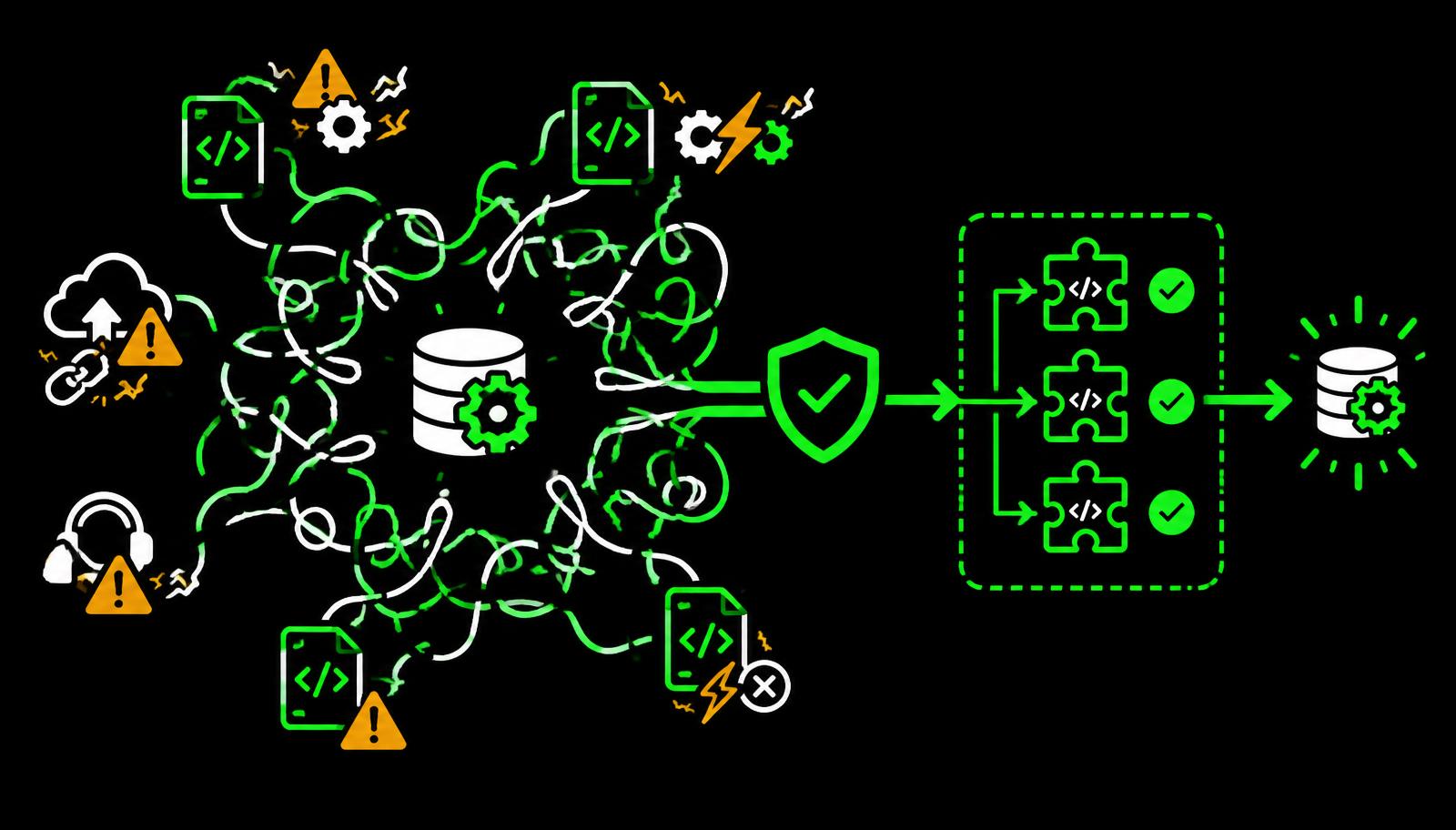
    Salesforce CPQ is designed to handle moderate complexity, but it was not designed to handle unmanaged growth. Most nightmare scenarios are caused by a layering effect that builds up quietly over years.

    • Cumulative logic. A pricing rule for a Q1 promotion. A product rule for a new compliance requirement. A custom script for a one-time edge case. Without a strategy to prune old logic, these layers begin to overlap, contradict and fight for resources.
    • The bundle trap. Bundled pricing is the silent killer of CPQ agility. Bundles are rarely static. When marketing changes a bundle price to respond to a competitor, the system has to re-evaluate every nested dependency, constraint and attribute. Tightly coupled logic turns a simple update into a cascade of errors across thousands of active quotes.
    • The black box problem. Eventually the architecture becomes so opaque that no single person understands the full calculation sequence. You are no longer managing a platform; you are managing a mystery.
    Bundled pricing is the silent killer of CPQ agility. If your logic is tightly coupled, a single price change can ripple through thousands of live quotes.

    Signs your CPQ is heading for a breakdown

    If you are not sure whether your system is at risk, look for these red flags.

    The shadow spreadsheet

    When sales reps start using Excel to double-check whether the CPQ price is actually correct, you have lost the battle for trust. The shadow spreadsheet is usually the first warning sign that the system has stopped being authoritative.

    The maintenance tax

    If 80 percent of your admin's backlog is fixing broken things rather than building new revenue-generating features, you are paying a heavy tax on your technical debt. Every quarter that passes without remediation makes the next change more expensive.

    Performance fatigue

    "The system is slow" becomes the default excuse for why quotes are not going out on time. Reps stop reporting issues because they assume nothing can be done. That silence is dangerous; it hides the real cost of the platform from leadership.

    Deployment anxiety

    If moving a change from sandbox to production feels like a high-stakes gamble where you are waiting for the phone to ring with complaints, your architecture is fragile. Confident teams deploy small changes often. Anxious teams batch everything into rare, painful releases.

    The real business impact: revenue friction

    This is not just an IT problem. A nightmare CPQ has a direct impact on your bottom line.

    • Slower quote turnaround. In modern sales, speed is a competitive advantage. If your CPQ is sluggish, competitors are winning deals while your reps wait for a page to load.
    • The ripple effect. A minor pricing error in a bundle can stay hidden until it hits a customer's inbox. Fixing it requires manual rework, apologies from sales and a significant hit to your credibility.
    • Hero dependency. The system begins to require heroics from one or two key experts just to stay operational. If those individuals leave, the system effectively becomes unmaintainable.

    Watch out

    If a single person is the only one who can confidently change your pricing logic, you do not have a CPQ. You have a single point of failure with a Salesforce licence.

    Why traditional scaling methods fail

    The problem is often structural. In many legacy setups, pricing rules, product rules and custom scripts operate in silos. There is no command centre to see how they interact. Worse, there is rarely a way to simulate a price change on a complex bundle before it goes live, which makes every update a live-fire exercise.

    A modern path forward: architecture over configuration

    The solution is not to stop customising; it is to start architecting for change. The teams that get out of the nightmare share a few common moves.

    • Decouple the logic. Stop hard-coding every variable. Use configuration tables and externalised pricing data so that changes do not require rewriting rules.
    • Simplify the bundle. Aim for logic-light bundles. Let the system handle the structure, but keep the pricing drivers as simple and visible as possible.
    • Make visibility a feature. Prioritise tools or processes that allow you to trace exactly why a price is what it is. If you cannot trace the logic, you cannot trust the result.
    • Embrace the AI layer. A new generation of AI-assisted tooling can analyse rule interactions and flag conflicts before they break production.

    Key takeaways

    • 1Most CPQ nightmares are caused by years of unmanaged layering, not a single bad decision.
    • 2Bundles and pricing rules need to be treated as living entities that require regular simplification.
    • 3Sustainable CPQ depends on architecture and visibility, not just configuration.

    Where ServiceNow CPQ on Logik.ai changes the picture

    The deepest fix for the customisation nightmare is a platform that does not punish you for needing change. ServiceNow CPQ on Logik.ai is built around exactly that: decoupled pricing, modular configuration, explainable logic and native AI that helps surface conflicts before they reach production. Business users can adjust rules with confidence, and reps stop dreading the bundle that always misprices.

    Trapped inside a nightmare CPQ?

    The longer the layering goes on, the harder it is to escape on your own timeline. Our CPQ practice has unpicked exactly these environments and landed teams cleanly on ServiceNow CPQ with Logik.ai, with the rules that matter intact and the ones that should not survive retired.

    Book a 30-minute CPQ untangling session → We will look at your most painful bundles and rules, and map a pragmatic path to a CPQ your team will actually trust.

    About the author

    Vinod Kumar Vattikuti, CPQ Technical Architect, Impactron

    Vinod Kumar Vattikuti

    CPQ Technical Architect, Impactron

    Senior CPQ Technical Architect with over a decade of proven expertise architecting and implementing end-to-end quote-to-cash solutions across SAP CPQ and Salesforce platforms. Specialises in complex product configuration, guided selling, dynamic pricing models and seamless multi-system integrations connecting CPQ with CRM, ERP and external enterprise systems for global organisations.

    Focus areas

    ServiceNow CPQ on Logik.aiSAP CPQ Architecture & ConfigurationGuided Selling & Dynamic Pricing

    Continue reading

    Related reading

    CPQ Insights

    The Real Problem with Salesforce CPQ Pricing Rules

    See how pricing rules add to the customisation burden.

    Read article
    CPQ Insights

    Why Salesforce CPQ Breaks at Scale: The Technical and Business Reality

    Understand why Salesforce CPQ breaks at scale.

    Read article
    CPQ Insights

    7 Signs Your CPQ Implementation Needs a Rebuild (Not a Patch)

    Check whether a rebuild beats another patch.

    Read article
    CPQ Insights

    When Should You Migrate Away from Salesforce CPQ?

    Decide when to migrate away.

    Read article

    Modernising CPQ? Let's talk.

    Our CPQ practice has led configuration-heavy programmes across manufacturing, technology and services. We know how to land ServiceNow CPQ on Logik.ai.

    Book a CPQ consultationExplore our CPQ capability
    Back to CPQ Insights

    ServiceNow

    • Consulting
    • Implementation
    • Support
    • Staff Augmentation

    GCC

    • Strategy
    • Setup
    • Success Stories
    • The GCC Blueprint

    Problems We Solve

    • Disconnected Journeys
    • Slow Service Ops
    • Manual Workflows
    • Visibility & Forecasting
    • Scaling Ops
    • Supplier & Procurement
    • Explore all →

    Customer Workflows

    • Sales & Order Management
    • Configure Price Quote (CPQ)
    • CPQ Insights
    • CRM Insights
    • Customer Service Management (CSM)
    • Field Service Management (FSM)
    • CRM Transformation
    • Source to Pay

    Industries

    • All Industries
    • London Insurance Market
    • Manufacturing
    • Technology & SaaS
    • Across Industries

    Company

    • Why Impactron
    • Leadership & Team
    • Proven Outcomes
    • Careers

    Office Locations

    London, UK office location
    London, UK
    Jodhpur, India office location
    Jodhpur, India
    Jaipur, India office location
    Jaipur, India
    Bengaluru, India office location
    Bengaluru, India

    © 2026 Impactron. All rights reserved.

    Review Whitepaper
    LinkedInEmail