
ServiceNow World Forum London · Breakfast, 20 October, 7.30 to 9.00 · Beside ExCeLWorld Forum London breakfast · 20 October→
    Impactron - ServiceNow Consulting & Implementation Partner
    • Experience
    Book Consultation
    • /servicenow
    • /servicenow-consulting
    • /servicenow-implementation
    • /servicenow-support
    • /servicenow-staff-augmentation
    • /solutions/challenges/disconnected-customer-journeys
    • /solutions/challenges/slow-service-operations
    • /solutions/challenges/manual-workflows
    • /solutions/challenges/visibility-forecasting
    • /solutions/challenges/scaling-operations
    • /solutions/challenges/supplier-procurement-operations
    • /solutions/customer-workflows/sales-order-management
    • /solutions/customer-workflows/cpq
    • /solutions/customer-workflows/csm
    • /solutions/customer-workflows/fsm
    • /industries/insurance-london-market
    • /industries/manufacturing
    • /industries/technology-saas
    • /case-study/tru-consulting
    • /gcc-success-stories
    • /resources
    • /resources/cpq
    • /resources/crm
    • /resources/insurance
    • /resources/insurance/glossary
    • /resources/events
    • /resources/gcc-best-practices-ebook
    • /whitepaper/gcc-vs-outsourcing
    • /blog
    • /about-us
    • /our-team
    • /careers
    Resources/CPQ Insights/Why Salesforce CPQ Breaks at Scale: The Technical and Business Reality
    Implementation Playbook

    Why Salesforce CPQ Breaks at Scale: The Technical and Business Reality

    Pricing fragmentation, recalculation overload, governor limits and bundle debt: the architectural reasons Salesforce CPQ quietly stops keeping up as enterprises grow, and how to design for the scale you plan to reach.

    Vinod Kumar Vattikuti
    Vinod Kumar Vattikuti
    CPQ Technical Architect
    Published 19 August 2026Updated 6 September 2026 7 min read Share
    Why Salesforce CPQ Breaks at Scale: The Technical and Business Reality

    A $1B company I worked with reached a stage where quoting became the slowest part of their sales cycle. Simple quotes were fine, but once deals crossed 100+ line items, things started falling apart. Calculations would take minutes, sometimes fail entirely, and reps were left refreshing their browsers hoping the system would just work.

    Eventually, the sales team stopped trusting the system and reverted to maintaining pricing in offline spreadsheets. From the outside, it looked like a mere performance glitch. From experience, I knew it was something deeper: the system had outgrown its design.

    What this article gives you

    An honest look at why Salesforce CPQ quietly breaks down as a business scales, the architectural reasons behind it, and the modern design choices that keep quoting fast at enterprise volume.

    The problem: visible symptoms, invisible root causes

    In my experience with Salesforce CPQ over the years, the real issues are rarely visible during the initial implementation. Early setups are clean: few products, simple pricing and minimal rules. But as a business matures, CPQ absorbs layers of complexity it was not always intended to hold.

    Pricing logic fragmentation

    What starts as a handful of price rules turns into a chaotic mix of discount schedules, contracted pricing, native price rules and custom QCP or Apex logic. I have seen environments where no single architect could confidently explain how a final price was derived. Everything works, until one small change triggers a cascade of errors.

    Recalculation overload

    Salesforce CPQ recalculates more often than users realise. Each time a line is added or updated, the engine triggers chains of logic across multiple objects. On large quotes, you are not just calculating a total; you are fighting against the clock.

    The governor limit wall

    Because Salesforce CPQ runs on the core Salesforce platform, it is bound by multi-tenant governor limits. As quote size and logic complexity increase, these limits become a ceiling. Single-threaded processing simply cannot keep up with enterprise-grade data volume within a single browser transaction.

    Bundle design debt

    Deeply nested bundles look organised on a whiteboard, but at scale they create an exponential number of combinations. This makes testing nearly impossible, allows edge cases to slip through and turns debugging into expensive guesswork.

    The system worked. It was the architecture that had quietly run out of room.

    The business impact: beyond the technical

    When CPQ breaks at scale, the damage is not just felt by the IT department. It hits the bottom line in places leaders feel before they can measure.

    • Decreased deal velocity. If a rep has to wait five minutes for a quote to calculate, the rhythm of the sales call is destroyed. Over thousands of quotes, this delay directly postpones revenue recognition.
    • Churn and lost deals. In competitive markets, speed is a feature. If your team cannot provide accurate pricing in real time, customers move to competitors who can.
    • The trust gap. The moment sales reps start double-checking system pricing manually, the CPQ investment has failed. Rebuilding that trust is far more difficult than fixing a script.
    • Operational overhead. Instead of building new features, admins and developers spend most of their time firefighting pricing discrepancies and manual recalculations.

    Why legacy architectures struggle

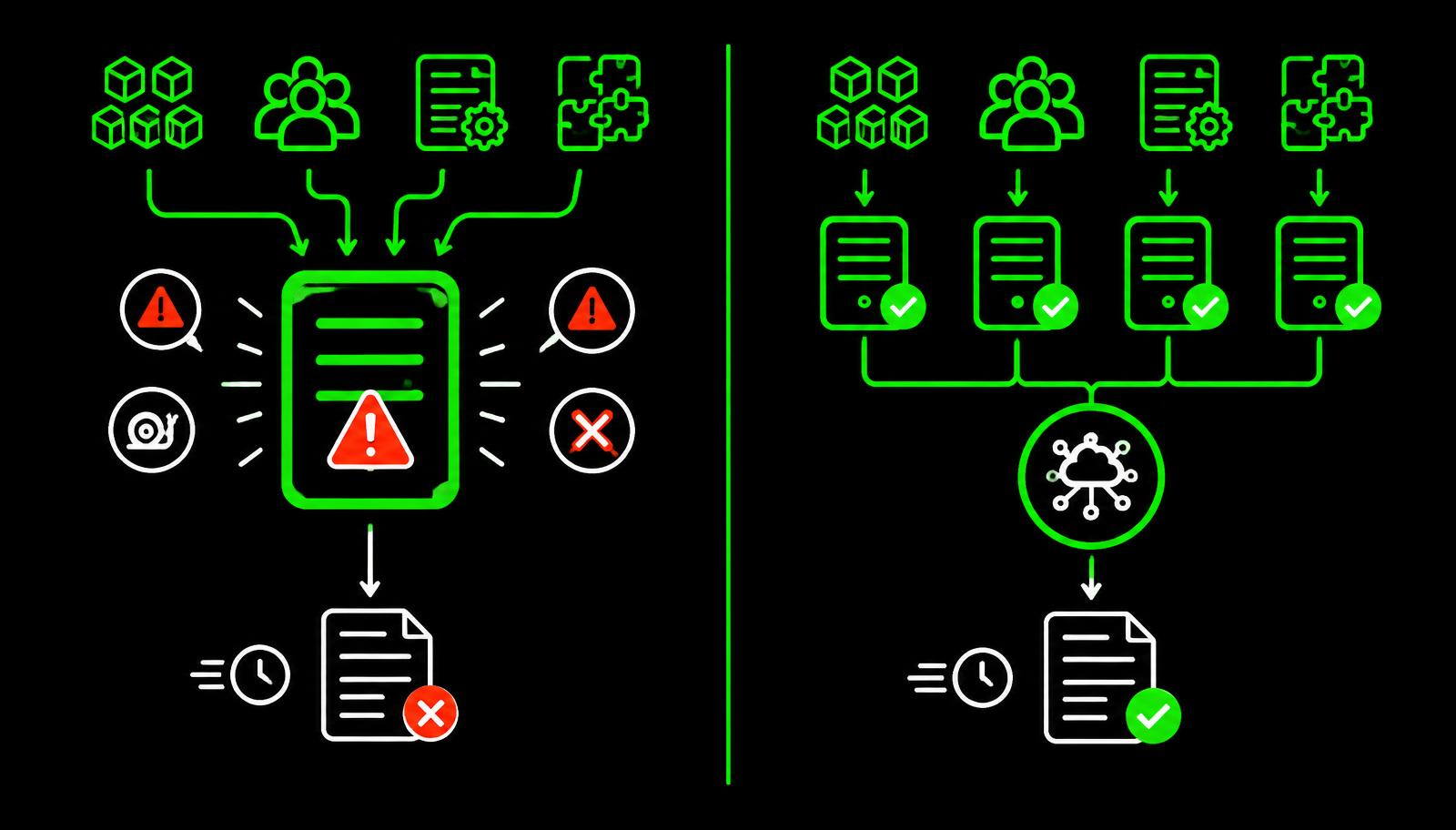
    Salesforce CPQ was built on a configuration-first philosophy. That is effective for controlled environments, but it struggles under the weight of continuous enterprise growth for three reasons.

    • Tight coupling. Pricing logic, product configuration and the execution engine are all squeezed into the same layer. You cannot optimise one without risking the others.
    • Execution environment. The platform's single-threaded nature is a fundamental bottleneck for massive data sets.
    • Fragile frameworks. There is rarely a dependency map for pricing rules. Teams become afraid to innovate or change prices because they do not know what might break.

    Watch out

    If your team hesitates before touching a price rule, you do not have a CPQ problem. You have an architecture problem. The hesitation is the warning.

    The modern approach: designing for scale

    Successful enterprise implementations are shifting away from monolithic CPQ towards a more distributed architecture, where each layer is allowed to do what it is best at.

    • Decoupling logic. Move heavy-duty pricing logic outside of the core CPQ engine into structured pricing services.
    • Flattening product models. Trade nested bundles for flatter, more performant product structures.
    • API-driven orchestration. Use CPQ as the orchestrator or the UI, but let specialised engines handle the heavy lifting of calculation.
    • Strategic AI. Implement AI not just for the sake of automation, but to ensure pricing consistency and identify logic overlaps before they reach production.

    Key takeaways

    • 1Complexity is cumulative. CPQ issues do not appear overnight; they build up until they reach a breaking point.
    • 2Performance is a business metric. Slow quotes equal slow revenue and quiet erosion of sales trust.
    • 3Architecture matters. Scaling requires moving from a configuration mindset to a systems engineering mindset.

    Where ServiceNow CPQ on Logik.ai changes the picture

    The architecture moves that unlock scale (decoupling logic, flattening product models, externalising heavy calculation, native AI for consistency) are exactly the design principles behind ServiceNow CPQ on Logik.ai. The pricing engine is purpose-built for speed and transparency, configuration sits in its own modular layer, and the whole experience runs on the same platform as service and fulfilment. The hesitation around touching a price rule largely goes away because the system is built to expect change.

    Hitting the scale wall on Salesforce CPQ?

    If your team is firefighting quote performance, recalculation storms or governor limits, this is the right moment to step back and look at the architecture, not the next patch. Our CPQ practice has re-platformed exactly these environments onto ServiceNow CPQ with Logik.ai.

    Book a 30-minute CPQ scale assessment → We will look at where your current implementation will break next and what a scalable destination state looks like.

    About the author

    Vinod Kumar Vattikuti, CPQ Technical Architect, Impactron

    Vinod Kumar Vattikuti

    CPQ Technical Architect, Impactron

    Senior CPQ Technical Architect with over a decade of proven expertise architecting and implementing end-to-end quote-to-cash solutions across SAP CPQ and Salesforce platforms. Specialises in complex product configuration, guided selling, dynamic pricing models and seamless multi-system integrations connecting CPQ with CRM, ERP and external enterprise systems for global organisations.

    Focus areas

    ServiceNow CPQ on Logik.aiSAP CPQ Architecture & ConfigurationGuided Selling & Dynamic Pricing

    Continue reading

    Related reading

    CPQ Insights

    The Real Problem with Salesforce CPQ Pricing Rules

    Dig into the pricing rule problem.

    Read article
    CPQ Insights

    Why Salesforce CPQ Customisations Become a Nightmare Over Time

    See how customisation debt accumulates.

    Read article
    CPQ Insights

    When Should You Migrate Away from Salesforce CPQ?

    Decide when to migrate away from Salesforce CPQ.

    Read article
    CPQ Insights

    The Risks of Running Legacy CPQ Systems in 2026

    Weigh the risks of staying put.

    Read article
    CPQ Insights

    What Is ServiceNow CPQ? Configure, Price, Quote Explained

    Explore ServiceNow CPQ as the alternative.

    Read article

    Modernising CPQ? Let's talk.

    Our CPQ practice has led configuration-heavy programmes across manufacturing, technology and services. We know how to land ServiceNow CPQ on Logik.ai.

    Book a CPQ consultationExplore our CPQ capability
    Back to CPQ Insights

    ServiceNow

    • Consulting
    • Implementation
    • Support
    • Staff Augmentation

    GCC

    • Strategy
    • Setup
    • Success Stories
    • The GCC Blueprint

    Problems We Solve

    • Disconnected Journeys
    • Slow Service Ops
    • Manual Workflows
    • Visibility & Forecasting
    • Scaling Ops
    • Supplier & Procurement
    • Explore all →

    Customer Workflows

    • Sales & Order Management
    • Configure Price Quote (CPQ)
    • CPQ Insights
    • CRM Insights
    • Customer Service Management (CSM)
    • Field Service Management (FSM)
    • CRM Transformation
    • Source to Pay

    Industries

    • All Industries
    • London Insurance Market
    • Manufacturing
    • Technology & SaaS
    • Across Industries

    Company

    • Why Impactron
    • Leadership & Team
    • Proven Outcomes
    • Careers

    Office Locations

    London, UK office location
    London, UK
    Jodhpur, India office location
    Jodhpur, India
    Jaipur, India office location
    Jaipur, India
    Bengaluru, India office location
    Bengaluru, India

    © 2026 Impactron. All rights reserved.

    Review Whitepaper
    LinkedInEmail