
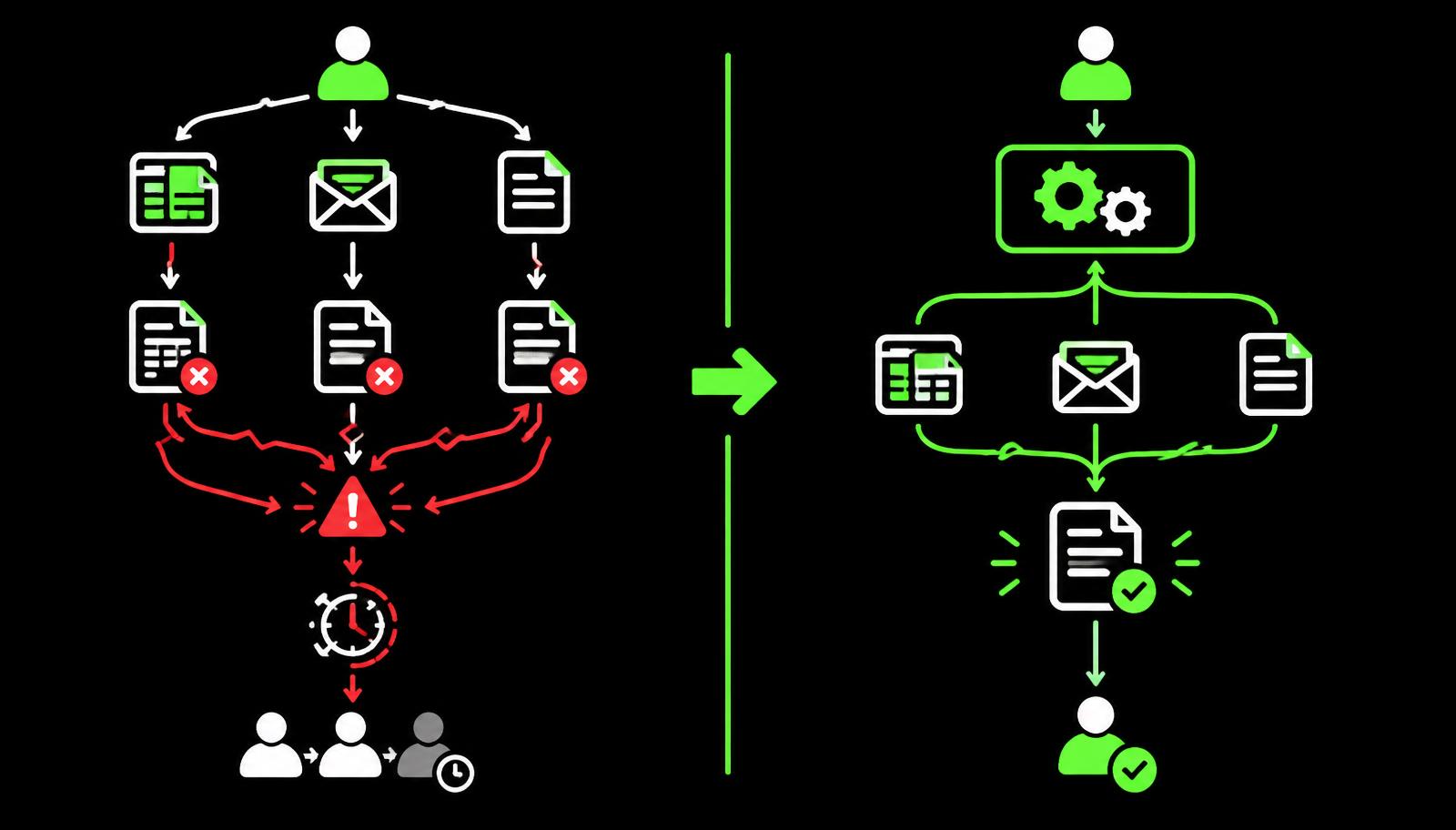
Quoting without a proper CPQ rarely looks broken from the outside. The damage shows up as deals that quietly cooled, margins that quietly slipped and reps who quietly stopped trusting the system.
A $200M B2B software company had 120 sales reps and a quoting process that averaged three to four days per deal. Rep raises a request. Sales ops pulls from a master spreadsheet. Manager approves over email. Quote gets built in Word, converted to PDF, sent out. One quarter, fourteen enterprise deals went cold, not during negotiation, not on price, while waiting for the quote to arrive. That is not a sales problem. That is an infrastructure problem.
Where the process breaks down
In companies without a proper CPQ, the architecture is never designed, it just accumulates. The CRM holds customer and deal data. The real pricing logic lives in a spreadsheet that three people have edit access to. Approvals happen over email. The quote itself gets built into a Word template someone made two years ago. And the exceptions, the special discount for that one enterprise account, the custom bundle that was approved last quarter, those live in someone's head.
Every quote is a manual assembly job. A rep has to touch four or five tools, apply rules they may or may not fully understand, get a human to approve it and format it correctly, all before a customer sees anything.
The failure points are everywhere. Reps use outdated pricing sheets because no one told them the Q3 rates changed. Discount approvals sit in a manager's inbox over a long weekend. Two reps quote the same product to two different customers at different prices because there is no single enforced source of truth. A configuration gets proposed that cannot actually be delivered, because nothing validated it before the quote went out.
This is not sloppiness. It is what happens when quoting complexity outgrows the tools built to handle it.
Where revenue quietly leaks
Quoting delays do not show up as a line item on a P&L. But they bleed revenue in four very specific ways.
Revenue delays
Enterprise procurement runs on deadlines. Budget cycles close, approval windows expire and buying committees move on. A three to four day quote turnaround in a market where competitors deliver in hours is not a minor inefficiency. It is a structural disadvantage baked into every deal your team pursues.
Deal loss
Buyers do not wait. While your sales ops team is chasing an email approval, the prospect is already reviewing someone else's quote. The deal does not end in a lost negotiation, it ends in silence. Most CRMs log it as "no reason given." The real reason is never captured.
Rep attrition
Your best reps did not join to manage paperwork. When 30 to 40 per cent of their week goes to quote admin, chasing approvals, fixing pricing errors, reformatting documents, they leave. And with them goes everything that never made it into the CRM: how key accounts were structured, what actually closed, what was promised.
Operational drag
Every manual quote is a risk that compounds downstream. A pricing error surfaces after the contract is signed. A discount that was never formally approved creates a legal dispute. RevOps cannot forecast reliably because deal data is inconsistent across reps. The cost is not just the time spent building the quote, it is everything that has to be corrected after it goes wrong.
Conservatively, companies without proper CPQ leave 5 to 10 per cent of addressable revenue on the table every year through quoting friction alone. It never shows up on a dashboard. That is exactly why it persists.
Why legacy CPQ struggles here
For companies that recognised this problem early and invested in a CPQ solution, the outcome was not always better. Legacy CPQ systems, tools like BigMachines, early Apttus, Cincom and on-premise SAP quoting modules, were built in an era before cloud-native architecture, open APIs and dynamic product catalogues existed. They solved the quoting problem for the world as it was in 2005, not as it operates today.
The structural issues run deep, and they are not bugs. They are architectural decisions that made sense then and do not now.
- Rigid, hard-coded configuration. Pricing rules and product logic are baked in by developers at implementation. Every change becomes a change request, a developer, a testing cycle and a deployment. In a business where pricing evolves quarterly, the system becomes unreliable almost immediately after go-live.
- No API-first design. These tools were built before modern integration was a requirement. Connecting them to a current CRM, billing platform or e-signature tool requires custom middleware, expensive to build, fragile to maintain and the first thing that breaks when either side updates.
- Monolithic architecture. Pricing engine, document generator, approval workflow and product catalogue are one bundled system. You cannot upgrade one piece without risking everything else.
- Implementation timelines that killed momentum. Legacy CPQ projects routinely ran nine to eighteen months from contract to go-live. By the time the system was live, the product catalogue had changed, the sales team had built workarounds and the executive sponsor had moved on.
The tragedy is not that these systems failed. It is that companies spent significant budget solving the quoting problem and still ended up with something the business worked around rather than inside.
What good looks like
The fix is not a faster approval email or a better spreadsheet. It is moving quoting into a platform where everything is already connected.
Modern CPQ built on ServiceNow does exactly that. Pricing logic, approvals, product configuration and contract generation run inside one unified system. When pricing changes, it updates everywhere, instantly, without a developer touching anything.
A rep configures a deal, pricing validates in real time, approvals route automatically and the quote goes out. No handoffs. No waiting. What took four days takes under an hour.
AI works quietly underneath, flagging undeliverable configurations before the quote goes out, surfacing what pricing closes fastest and catching revenue leakage early. Your average rep starts performing like your best one.
That is what quote-to-cash looks like when the infrastructure actually works.