
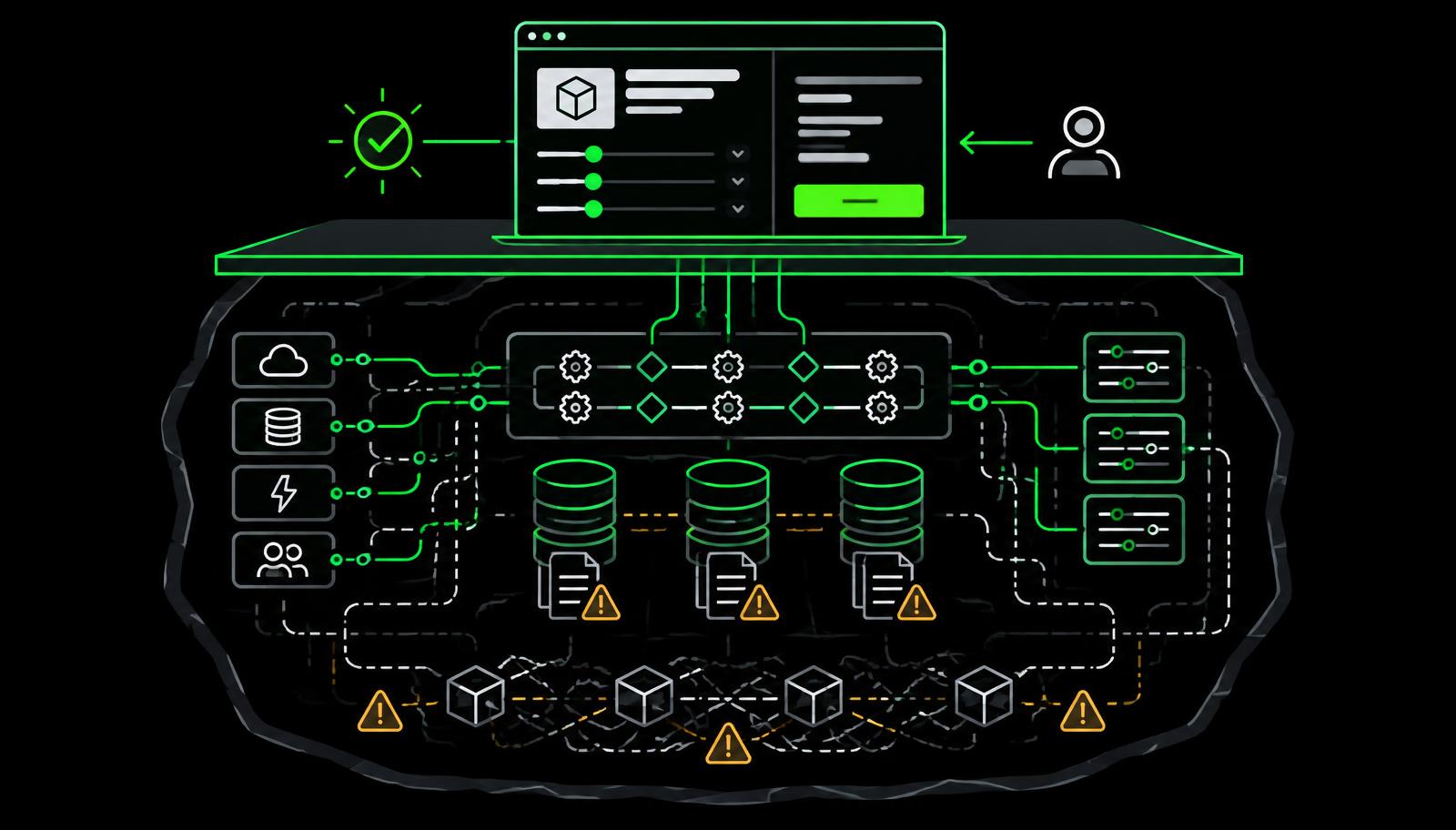
Oracle CPQ is a capable platform. The trouble is rarely the software itself. It is what accumulates inside it over the years, layer by layer, until the system that was meant to accelerate selling quietly becomes the thing that holds it back.
The deal that almost didn't close
It is a Thursday afternoon. A senior rep at a mid-sized industrial manufacturer has been working a $2.3M enterprise deal for six months. The buyer is ready to sign, but wants a revised quote that reflects a last-minute change to the product bundle. On paper, a few clicks.
The rep opens Oracle CPQ, applies the change, and watches the system think. Twenty minutes later a pricing error appears. Discounts are not applying correctly to the new bundle. IT gets involved, traces the issue to a rule conflict buried in an override layer added eighteen months ago by a consultant who no longer works there.
By the end of the day, no quote has gone out. By Monday morning, the buyer is in conversation with a competitor.
What is actually going wrong
Rule sprawl and fragmented pricing logic
Oracle CPQ's pricing engine is built on layered rule sets: product constraints, pricing matrices, discount schedules, attribute-based adjustments, approval hierarchies. In theory, elegant. In practice, most enterprises carry hundreds of rules written by different teams across different years, with thin documentation and meaningful overlap. When a new product line launches, teams add new rules on top of old ones rather than refactor. The result is a brittle stack where changing one rule triggers cascading conflicts that only surface during live quoting, not in testing.
Integration debt with CRM and ERP
Oracle CPQ rarely runs in isolation. It connects to Salesforce or Oracle Sales Cloud for opportunities, and to ERP systems like Oracle EBS or SAP for inventory and fulfilment. Every integration point is a potential failure mode. Pricing data from ERP can arrive stale. Customer-specific contract pricing may not map cleanly to CPQ product structures. These gaps do not show up in demos. They show up in production, during high-stakes deals.
Configuration complexity that outpaces governance
Manufacturing, telecom and technology companies often run catalogues with thousands of SKUs and deeply nested configuration dependencies. As products evolve and CPQ administrators turn over, the configuration layer becomes harder to validate or audit. Eventually, no one in the room can confidently explain why a particular quote produced a particular price.
Power, without governance, becomes debt. That is the quiet story of most Oracle CPQ implementations at scale.
The cost no one is measuring
Engineering teams describe CPQ problems as technical issues. The business describes them as revenue problems. Both are right, but the second framing is the one that drives change.
Revenue cycle drag
A quote that should take fifteen minutes takes two hours. Multiply that across a fifty-person sales team running three hundred opportunities a month and the drag becomes measurable. Even a one-week delay in quote delivery materially affects close rates on long enterprise cycles.
Lost deals and damaged trust
Pricing errors erode buyer confidence quickly. Enterprise buyers making seven-figure commitments read quoting mistakes as signals about operational reliability. A botched quote is not just a missed deal, it is a relationship that can take years to rebuild.
Shadow processes
When sales teams lose faith in the system, they route around it. Reps maintain offline pricing spreadsheets. Managers approve discounts on Slack. Finance later discovers margin leakage they cannot explain. The system is still in place, but the process it was meant to govern has migrated into the shadows.
The IT tax
Maintaining a fragile CPQ implementation is expensive. IT teams spend significant time firefighting rule conflicts, debugging integration failures and managing change requests that should be routine. Every hour on CPQ maintenance is an hour not spent on the next capability.
Why Oracle CPQ struggles here, structurally
This is not a story about a bad product. It is a story about structural choices that compound at scale.
- Monolithic rule architecture. The engine is designed for stability, not agility. Adding or changing rules needs careful sequencing and thorough regression testing. In businesses where pricing shifts quarterly and product lines expand annually, that creates a natural bottleneck.
- Limited observability. When a quote produces an unexpected number, native tooling offers little insight into which rule fired or which integration returned a bad value. Debugging needs expert-level platform knowledge that is rarely distributed across the team.
- Configuration as code, without the discipline of code. CPQ configuration is functionally software development, but it is rarely treated that way. No mandatory version control, no formal review, no automated test suites. Technical debt accumulates in ways a healthy codebase would not tolerate.
- Upgrade and customisation tension. Heavily customised implementations face a painful trade-off: stay current and risk breaking custom logic, or freeze the platform and lose access to new capabilities. Most enterprises end up on outdated versions, which only compounds the maintenance burden.
A smarter way to think about CPQ architecture
The platforms that escape this trap tend to do four things differently.
Treat configuration as a managed engineering asset
Version-controlled configuration exports. Documented rule logic. Defined ownership. Regular audits of deprecated or conflicting rules. The teams that invest here spend dramatically less time firefighting.
Design integration contracts explicitly
Failures between CPQ, CRM and ERP are almost always rooted in assumptions no one wrote down. Explicit contracts, with clear data ownership and validation rules, remove an entire category of production incidents.
Build toward modularity and observability
Separate the configuration layer from the pricing engine, and the pricing engine from approval workflow. Pair that with structured logging and most incidents become diagnosable in minutes, not days.
AI-augmented configuration and pricing
The forward-looking organisations are exploring AI inside CPQ: surfacing recommended configurations, flagging pricing anomalies, predicting approval outcomes. Early adopters are seeing meaningful reductions in quote cycle time and error rates. The architecture you choose today decides how easily you can layer those capabilities tomorrow.
The Oracle CPQ failure mode is rarely the software. It is the absence of engineering discipline around it.
Where ServiceNow CPQ on Logik.ai changes the picture
Most of what makes Oracle CPQ painful at scale, monolithic rules, opaque pricing, brittle integrations, slow change cycles, is architectural. So the more useful question is not "how do we patch Oracle CPQ", it is "what would a CPQ designed for today actually look like". ServiceNow CPQ, powered by Logik.ai, is one of the clearest answers in the market right now.
- Modular by design. Configuration, pricing and approvals are kept distinct enough that a change in one does not silently break another. Business teams can move on pricing without queueing behind a release train.
- Pricing logic that is explainable. Logik.ai's engine is fast and transparent, so reps and finance can see how a price was actually built, not guess at it after the fact.
- One workflow fabric. Because CPQ sits inside ServiceNow, quote-to-cash, service, fulfilment and approvals run on the same platform. The handoffs that quietly create errors in an Oracle, Salesforce and ERP triangle largely disappear.
- AI is native, not bolted on. Guided selling, configuration recommendations and pricing assistance are built into the platform, so the experience improves without another integration project.
- Built for modern commercial models. Subscriptions, usage-based pricing, hybrid bundles and renewals are first-class concepts, not workarounds layered onto a catalogue model from a different era.
The practical effect is the one sales actually feels. Quotes generate in seconds. Business users adjust rules themselves. Reps see fewer surprises in approvals. Deals move at the pace the buyer expects, not the pace the system allows.