
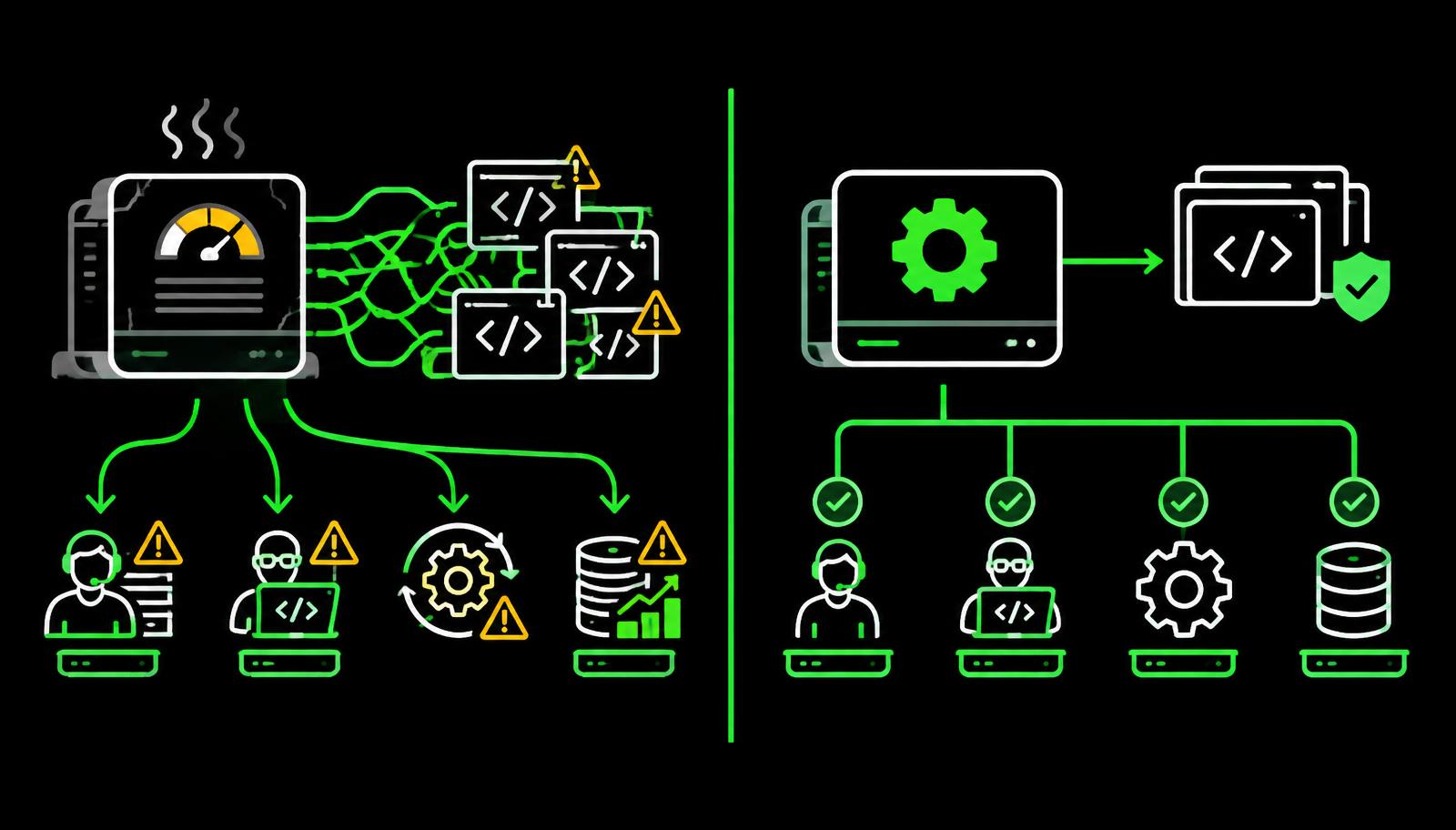
A £300m manufacturing company had been running Oracle CPQ for six years. Their sales team closed complex, multi-product deals: dozens of configurations, custom pricing rules, tiered discounts. On paper, Oracle CPQ was the right tool for the job. In practice, every time the product catalogue changed, a new SKU, a revised margin threshold, a bundling rule, the internal team logged a ticket, waited for a consultant and watched timelines slip.
A pricing update that should have taken a day stretched into three weeks. Their best enterprise reps started offering discounts off the cuff just to close deals faster, because the system could not keep up. The tool they bought to accelerate revenue had quietly become its biggest bottleneck.
What is actually going wrong inside Oracle CPQ
Oracle CPQ was engineered for a different era of enterprise selling. Its architecture is deeply relational. Rules, constraints and pricing logic are stored in tightly coupled database structures that need trained specialists to modify. Unlike modern configuration platforms built on flexible, API-first designs, Oracle CPQ's rule engine forces most changes to be implemented at the data layer, not through a visual interface.
The result is predictable. Every business-logic change, a new product attribute, a pricing tier update, an approval workflow adjustment, requires direct system intervention. Most of these changes are not achievable by a business analyst or a sales ops manager. They need a certified Oracle CPQ developer, or more often, an external implementation partner. What looks like a configuration problem is really an architecture problem: the platform was not built for self-service modification.
Testing compounds the pain. Because the rules are interdependent, even small changes trigger regression cycles across dozens of product combinations before anything can be deployed. The cost is not just money, it is organisational velocity.
Routine pricing changes that take a day on a modern CPQ can absorb three weeks of consultant and regression effort on Oracle CPQ. That is not a tooling problem, it is an architecture problem.
The revenue you cannot see leaking
The financial consequences rarely show up as a single line item, which makes them easy to ignore until you look at the pattern. Four leaks tend to repeat across Oracle CPQ estates.
Revenue delays
Quote cycles stretch by 40 to 60 per cent when catalogue updates lag behind sales conversations. Deals stall in negotiation while pricing is "being updated", and pipeline coverage quietly slips.
Deal loss
Enterprise buyers on tight timelines pick competitors who can price and configure faster. Speed to quote is now a competitive moat, especially in renewals and competitive displacement situations.
Sales workarounds
Reps bypass the system entirely with spreadsheets, manual quotes and undocumented discounts. Pricing discipline erodes, margin visibility breaks down and the CPQ stops being the system of record without anyone formally agreeing to that.
Operational cost
Consultant fees for routine updates eat into the bottom line, particularly for mid-to-large implementations, before you count internal FTE overhead, change-control overhead and the cost of regression cycles.
The structural limits of Oracle CPQ
Oracle CPQ was not designed to be maintained by the people closest to the business. It was designed to be implemented once, by specialists, and run in a stable state. That assumption breaks down quickly in modern go-to-market environments where product portfolios shift quarterly and pricing strategy evolves constantly.
Three structural issues compound over time.
- A monolithic data model. Pricing logic, product structure and approval workflows are tightly interwoven, which makes isolated changes risky and regression-heavy.
- A painful upgrade path. Major version updates frequently break custom configurations, forcing another round of consulting engagement just to stay current.
- An admin layer not built for business users. Rules are expressed in a proprietary scripting language that sales ops cannot read or modify without dedicated training.
What smarter CPQ architecture looks like
Organisations getting the most from their CPQ investment share a few architectural principles. They have moved away from systems where the rule engine is owned by IT, toward platforms where sales ops, pricing managers and product teams can make changes directly, in hours rather than weeks.
Modern CPQ platforms are API-first, which lets them sit comfortably between CRM and ERP without becoming the bottleneck between them. Pricing logic is expressed as configurable rulesets, structured data rather than proprietary code, so non-developers can read, test and modify it. Change management becomes a product workflow, not a service ticket.
AI-driven configuration assistance is increasingly embedded inside the quoting experience, surfacing recommended bundles, flagging margin risks and auto-resolving configuration conflicts before a rep ever clicks submit. The goal is not just automation, it is removing the distance between the person who understands the deal and the system that prices it.
None of this requires a full rip and replace overnight. It does require honest accounting of what your current CPQ maintenance cost, in pounds, in time and in deals that quietly do not close, actually adds up to.
Where ServiceNow CPQ on Logik.ai changes the picture
Most of what makes Oracle CPQ expensive to maintain is architectural, not a tooling gap that another integrator can patch. The more useful question is not "how do we squeeze another year out of Oracle CPQ", it is "what would a CPQ designed for the way we sell and price now actually look like". ServiceNow CPQ, powered by Logik.ai, is one of the clearest answers in the market right now.
- Business-owned change. Pricing tiers, discount thresholds, bundle logic and approval rules are configured in a clear, visual model that pricing and sales ops can safely manage themselves.
- Modular, API-first architecture. CPQ sits cleanly between CRM and ERP instead of becoming the bottleneck between them, with native integration into the rest of the ServiceNow workflow fabric.
- Predictable upgrades. Configuration is separated from the platform core, so version upgrades stop breaking custom logic and stop triggering another consulting cycle.
- AI as a first-class citizen. Logik.ai brings guided selling, configuration recommendations and pricing assistance directly into the quoting flow, so reps quote faster and protect margin without leaving the system.
- One observable system of record. Pricing, discounts and approvals stay inside the platform instead of leaking into spreadsheets, which restores both pricing discipline and forecast confidence.
The practical effect is the one finance and sales leadership both feel. Routine pricing changes ship in hours. Reps quote at the pace the buyer expects. Consultant retainers stop being the default answer to every catalogue update. And the conversation in QBRs moves from "why is CPQ slowing us down" back to "where do we go next".