
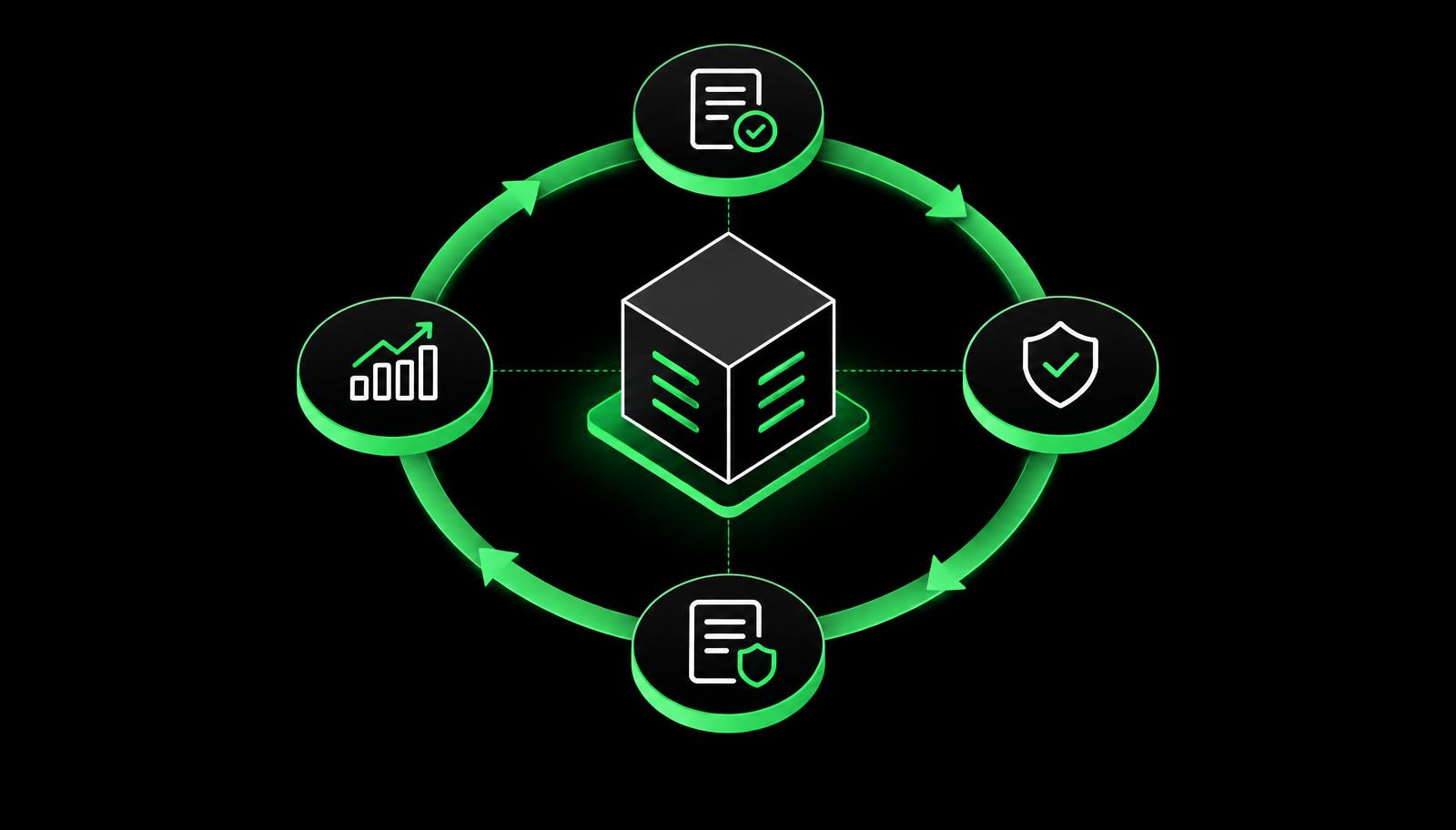
What moves, and what stays exactly where it is
Stays in the core
- Policy and risk data of record
- Coverage terms and endorsements
- Reserves, payments and the ledger
- Regulatory and statutory reporting data
Moves to the workflow layer
- Routing, ownership and hand-offs
- Exception and referral management
- Evidence capture and audit trail
- Operational reporting and SLAs
Most insurers do not lack systems. They lack a dependable way to move work between them.
Policy administration, claims and finance platforms do what they were designed to do: record transactions, apply product rules, calculate money and preserve an auditable history. The difficulty begins when a piece of work crosses the boundary of one system. A submission needs missing evidence. A claim requires an expert report and reserve approval. A premium discrepancy moves between underwriting, reinsurance and finance. The core may hold the right record, but it does not necessarily coordinate every person, decision and deadline around it.
That is why email becomes the routing engine, spreadsheets become unofficial queues and meetings become the mechanism for finding stalled work. The result is not only inefficiency. It is a control problem: ownership is unclear, evidence is scattered and leaders see the delay only after a customer, broker or regulator feels it.
Faced with that frustration, management teams are often presented with a false choice: tolerate the fragmentation or replace the core. Some core platforms genuinely do need to be replaced. But where the transaction engine remains reliable, much of the operational friction can be removed without beginning there.
Why separating systems of record from the work comes first
A system of record answers the question, "What is true?" It holds the policy terms, claim status, reserve, payment, premium, ledger entry or other authoritative transaction. Those records must remain subject to the product rules, financial controls and audit requirements of the specialist platform.
A system of action answers a different question: "What needs to happen next?" It creates the case, assigns the work, starts the clock, requests missing information, routes an approval, manages an exception and records the evidence that the step was completed.
This is the role ServiceNow can play. It can coordinate the work around policy, claims and finance platforms without pretending to replace them. The distinction sounds simple, but it is the architectural discipline on which the whole approach depends.
If the workflow layer duplicates pricing logic or ledger balances, it is becoming a shadow core. If it only displays data without owning the task, it is an expensive dashboard.
A useful system of action sits between those two failures. It owns the governed movement of work, while the specialist systems continue to own the transaction.
What a layered architecture for insurance modernisation looks like
The architecture has four layers. Each has a distinct job, and the boundaries matter more than the product names. Demand should enter through a coherent experience; operational work should be coordinated in one place; integrations should be controlled and observable; and authoritative records should remain in the systems designed to hold them.
1. Demand enters once
Customers, brokers, employees and external specialists should not need to understand the insurer's application estate. A request may arrive through a portal, an API, a telephone conversation or a monitored email channel, but it should be converted into one identifiable case with the right metadata, owner and service expectation. The channel can vary; the operational record of the work should not.
2. The system of action holds the operational context
The workflow layer holds what is needed to move the case: the task plan, responsibilities, approvals, deadlines, correspondence, exceptions and audit history. It may display selected policy or claim information to give a handler context, but it should reference the authoritative source rather than create a competing version of the truth.
ServiceNow describes its Financial Services Operations for Insurance offering in similar terms: connecting teams and technologies, bringing claim history and real-time data into role-based workspaces, tracking service levels and routing work to middle and back-office teams. The useful point is not the breadth of the product catalogue. It is the ability to make cross-system work visible and governable.
3. Integration is designed as part of the product
This layer is where many otherwise sensible programmes fail. A workflow is only as reliable as the interfaces beneath it. Every integration needs an owner, a clear data contract, least-privilege access, error handling, retry logic, monitoring and reconciliation. Point-to-point connections built for a single release quickly become another form of legacy.
ServiceNow Integration Hub supports API-led connections, reusable spokes, inbound API or webhook triggers and remote tables that can expose external data without importing it for permanent storage. Workflow Data Fabric extends that idea by connecting and contextualising data with governance and lineage. Those capabilities are useful, but they do not remove the need for deliberate interface design.
4. Systems of record remain authoritative
The policy platform should still price, quote and bind. The claims platform should still hold coverage, reserves and payments. Finance systems should still own the ledger and settlement record. The system of action can request or initiate an authorised transaction, then record the response and continue the workflow. It should not quietly reproduce the specialist logic that made the core authoritative in the first place.
What changes in practice for underwriting, claims and finance
Underwriting referrals
A submission arrives and is registered once. The system of action checks whether the required information is present, requests what is missing and routes the referral according to class, authority and urgency. The underwriter sees the relevant submission and policy context in one workspace, but pricing and bind remain in the underwriting or policy platform. The workflow records who decided, under which authority and how long the case waited at each step.
Claims coordination
The claim identifier in the claims platform anchors the work. The workflow layer coordinates evidence requests, loss-adjuster appointments, supplier actions, customer updates, internal reviews and approval tasks around it. When a reserve or payment decision is made, the authorised transaction is completed in the claims system and the outcome returns to the case. The claims platform remains the financial record; the system of action makes the surrounding obligations visible.
Finance and reinsurance exceptions
A premium mismatch, overdue recovery or reconciliation break can be managed as a structured exception rather than a line on a spreadsheet. The case carries the evidence, due date, accountable owner and approval history across underwriting, reinsurance and finance. Contract interpretation, calculations and postings remain in the specialist systems. What changes is the discipline with which the exception is progressed and closed.
Across all three examples, the improvement does not come from moving more data into another platform. It comes from removing the gaps between transactions: the unowned hand-off, the missing evidence, the approval sitting in an inbox and the exception that no one can see ageing.
Three executive tests for the target architecture
The same design is viewed differently from the operations, technology and finance seats. A credible first release has to satisfy all three.
| Executive lens | The question that matters | Evidence required before scale |
|---|---|---|
| COO | Is work moving faster and with clearer ownership? | Waiting time, manual touches, aged cases, rework, service-level breaches and customer chasing. |
| CIO and enterprise architect | Are system boundaries explicit and the integrations supportable? | Source-of-truth map, interface ownership, access controls, monitoring, reconciliation and recovery design. |
| CFO | Is value being proved before capital and run cost increase? | Baseline cost, staged funding, adoption, avoided rework, operating cost and a clear scale-or-stop decision. |
These tests are deliberately connected. A process that moves faster by copying uncontrolled data fails the CIO test. An elegant architecture that does not reduce waiting, rework or service failure fails the COO test. A business case that depends on an enterprise-wide rollout before any benefit appears fails the CFO test. The right first use case passes all three at a scale the organisation can govern.
What workflow orchestration does not solve
Workflow-first modernisation is not a reason to postpone core replacement indefinitely. The core itself needs attention when the constraint sits inside the transaction engine rather than around it.
The system-of-action approach also fails when it is used carelessly. Copying whole policy or claims records creates ambiguity. Rebuilding specialist rules in workflow code creates a second core. Synchronous integrations without timeouts or recovery paths make the coordination layer a new point of failure. A transitional architecture is worthwhile only when its boundaries and operating costs are explicit.
The decision, therefore, is not "workflow or core" for all time. It is a more useful question: what is limiting performance now, and which layer should own the remedy?
How to reach production without replacing the core system
This is where cost and implementation risk become manageable. Fund the first release as a bounded operational intervention, not as the opening chapter of an assumed enterprise rollout.
- 01
Choose one value stream
Select a process with visible friction, sufficient volume and a clear boundary around the first release.
- 02
Establish the baseline
Measure demand, waiting, manual touches, rework, service failures and current operating cost before changing the process.
- 03
Draw the source-of-truth map
State which system owns every material field, rule, decision and transaction. Resolve ambiguity before build begins.
- 04
Design for failure
Define access, timeouts, retries, reconciliation, fallback procedures, monitoring and operational support alongside the happy path.
- 05
Release narrowly
Limit scope by product, channel, claim type, exception class or business unit. Keep human authority where the decision is material.
- 06
Scale, change or stop on evidence
Compare performance with the baseline, include run cost and adoption, and decide whether to extend the workflow, address the core or end the intervention.
This sequence creates an important option for the CFO and CIO: continue funding where value and control are evident, while keeping the larger core decision separate until the evidence justifies it. It also gives the COO something more useful than a transformation milestone, namely a working process with measurable performance.
Where ServiceNow fits alongside policy and claims systems
ServiceNow Financial Services Operations for Insurance provides insurance-specific workspaces and workflow capabilities across servicing, underwriting, claims and complaints. Integration Hub and Workflow Data Fabric support connections to external systems and governed access to data. Together, those capabilities make the platform a credible system of action where the operating model and architecture call for one.
The technology does not make the boundary decisions on its own. Leaders still need to decide what the case owns, what remains in each core, which data can be referenced or copied, how write-back is authorised, and how the whole service behaves when an interface or downstream system is unavailable.
AI can be introduced later for document summarisation, classification, recommended next steps or routine task execution. It should sit inside the same controls: trusted data, explicit authority, human review for material decisions and a complete audit trail. Automating an unclear process simply makes the ambiguity travel faster.
A useful first engagement is therefore architectural as much as operational. Impactron's insurance practice supports organisations in selecting the first value stream, defining the system boundaries and delivering the workflow and integration layer on ServiceNow. The objective is not to move insurance onto another platform. It is to make work move reliably across the platforms the insurer already depends on.
Modernising without replacing the core is not a compromise when the core still performs its core job. It is a precise intervention: keep the records stable, make the work visible, prove the value and then decide how far to go.
A workflow layer around an unchanged core
Systems of record
- Policy administration
- Claims platform
- Finance and ledger
- Broker and market interfaces
Orchestration layer
- Single work queue across systems
- Ownership and escalation rules
- Integration and exception handling
- Operational reporting and evidence
Measured outcome
- Reduced manual re-keying
- Visible cycle time by process
- Exceptions cleared, not absorbed
- Core replacement decided on evidence