
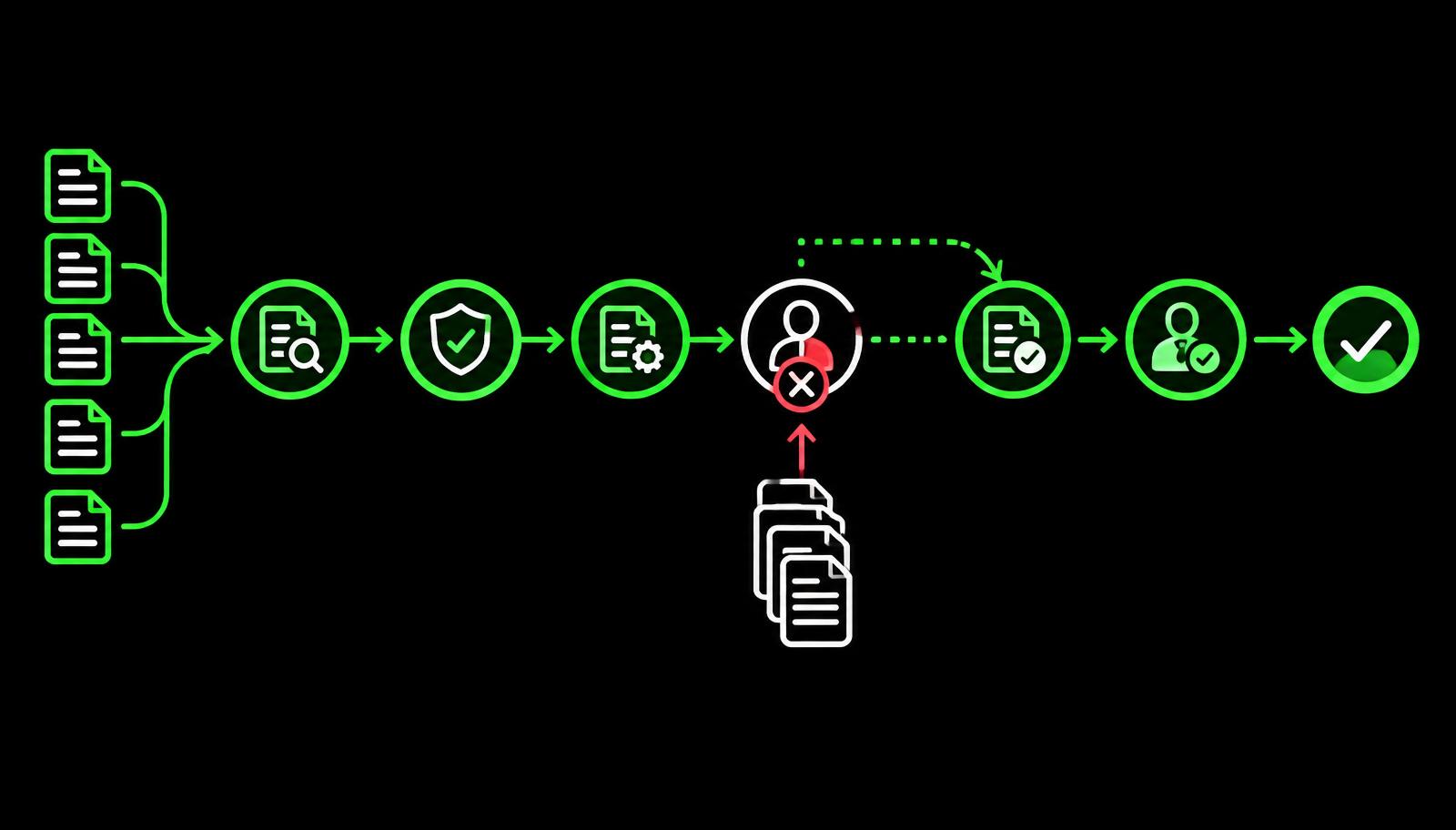
Where the time actually goes
- 1
Submission arrives
Email and attachments, with no consistent record that the risk is now in the house.
- 2
Allocation
Judgement about who should look at it, often made informally and repeated.
- 3
Appetite screening
Answered from memory or a document rather than from a rule everyone can see.
- 4
Data chasing
The single largest source of dwell time, and the least visible in reporting.
- 5
Referral
Waiting on an authority holder, with no shared view of the queue.
- 6
Subjectivity clearance
Owned after bind by nobody in particular until renewal exposes it.
- 7
Post-bind admin
Rekeying into policy, credit control and reinsurance records.
Specialty underwriters are hired to make difficult calls: to understand unusual exposures, read the quality of a risk beyond the submission form, negotiate intelligently with brokers and decide where an insurer should deploy its capital. In many underwriting businesses, that is not where most of their day goes.
Experienced people instead find themselves chasing missing schedules, working out who owns a submission, requesting the same information twice, seeking approvals through email chains and trying to establish whether a subjectivity has actually been met. These are not minor inconveniences. They slow response times, frustrate brokers, reduce underwriting capacity and, over time, make it harder to maintain a consistent standard of risk selection.
The central issue is not that specialty underwriting has become too complex. Complexity is inherent to the market. The issue is that too much operational friction sits around the underwriting decision. The most effective response is to identify where work gets stuck, separate administrative activity from technical judgement and create a workflow that helps underwriters spend more time on the risks that genuinely need their expertise.
Complexity is not the problem. The friction that has accumulated around the underwriting decision is.
Seven workflow bottlenecks in specialty underwriting
Bottleneck 1 of 7
Incomplete submissions create avoidable rework
The most common bottleneck begins before the underwriter has had a meaningful opportunity to assess the risk. A submission may contain a proposal form but no detailed schedule, outdated claims information, unclear turnover figures, missing contractual details or several attachments with inconsistent exposure data. The underwriter is then left to reconstruct the picture through a series of emails and calls.
That work is often treated as a normal part of underwriting, but it carries a significant cost. Every clarification request introduces delay. Every delay creates the possibility that the broker will approach another market. Every manually handled request increases the chance that important information sits in an inbox rather than in the underwriting record.
A stronger process starts with structured intake. Before a submission reaches an underwriter, the organisation should be able to identify whether the information needed for a basic assessment is present. That does not mean a rigid, one-size-fits-all checklist. Different specialty classes require different evidence. It means defining the minimum viable information needed to decide whether a risk is in appetite, requires referral or should be declined.
A professional indemnity submission may need a clear breakdown of revenue, services performed, jurisdictional exposure and historic claims. A property risk may require construction details, occupancy, values, location-level exposure and relevant risk-improvement information. When those requirements are visible at the point of submission, the broker receives a clearer request and the underwriter receives a cleaner file.
Bottleneck 2 of 7
Poor allocation sends work to the wrong place
In specialist markets, not every underwriter can write every risk. Authority may vary by product, geography, line size, industry sector, broker relationship or exposure type. Submissions are nevertheless frequently sent to generic mailboxes or allocated on availability rather than expertise.
This creates a familiar pattern. One person receives the submission, reads it sufficiently to understand it, then passes it on. The next person may need further information, may not have authority, or may decide it needs yet another referral. By the time the correct decision-maker becomes involved, valuable time has been lost and the broker has experienced an opaque process.
Allocation should reflect more than workload. It should account for underwriting capability, authority, risk characteristics and business priorities. A well-designed workflow can use basic information such as class of business, territory, insured revenue, limit requested and broker to route work to the right team from the outset.
This does not remove management judgement. During a surge in submissions or a market event, leaders may deliberately rebalance work across teams. They should be able to do so consciously, with visibility of the consequences, rather than relying on informal redistribution through inboxes.
Bottleneck 3 of 7
Appetite checks are often too informal
Most insurers have a risk appetite statement, underwriting guidelines and delegated authority limits. The challenge is making them usable in the moment an underwriter is deciding. If appetite exists only in a policy document, a slide deck or the memory of senior underwriters, it will be applied inconsistently.
Some appetite decisions are straightforward. A class may be excluded in a particular territory. A risk may exceed a pre-defined line size. An activity may sit outside the underwriting strategy. Workflow rules can flag those early and prevent time being spent on a risk that is highly unlikely to proceed.
Other cases require interpretation. A risk may technically sit within appetite but raise concerns because of recent claims, unusual contractual obligations, an emerging technology exposure or a stressed industry sector. A system cannot make that judgement in isolation. What it can do is surface the relevant question, ensure the underwriter has access to guidance and make the referral route clear when a risk sits near or outside the normal boundary.
The objective is not to turn appetite into a blunt automated rulebook. It is to make underwriting standards visible, consistently applied and open to challenge where expert judgement is required.
Bottleneck 4 of 7
Referral and approval depend too heavily on email
Referral is a normal and necessary control in specialty underwriting. Senior authority holders need visibility of large lines, unusual exposures, pricing deviations, coverage extensions and risks that fall outside ordinary parameters. The problem arises when referrals are managed through long email threads carrying several versions of the same information.
Email does not provide a reliable view of whether a decision is pending, who is accountable, what information has been reviewed or whether an approval included specific conditions. It is also difficult to analyse. A business may know it has slow turnaround times, but not whether the problem lies in submission quality, authority thresholds, unavailable approvers or repeated requests for evidence.
A more mature approach treats a referral as a controlled case. The underwriter submits the relevant risk information, identifies why the referral is needed, attaches supporting material and requests a defined decision. The authority holder can approve, decline, request further information or approve subject to documented conditions.
That creates a complete decision trail. It also makes it possible to measure referral volumes, approval turnaround, recurring exceptions and the points at which underwriters repeatedly seek support. Those insights reveal whether an authority framework needs adjustment, whether training is required, or whether the business is receiving a type of risk it is not operationally set up to handle.
Bottleneck 5 of 7
Subjectivities are created but not actively managed
Subjectivities can be essential controls. They may require the insured to provide evidence of risk improvements, confirm the use of specific contractual terms, complete a survey, install protection measures or satisfy a condition before cover attaches. Once a risk is bound, those conditions often lose visibility.
They may sit in a policy document, an underwriting note or an email exchange. The underwriter may remember them, but the next person managing the account may not. At renewal, the business may discover that an important requirement was never completed, or that the evidence exists but was never formally reviewed.
The first step is to distinguish clearly between different kinds of outstanding item. A pre-bind requirement is not the same as a condition precedent. A risk-improvement action is not the same as a request for routine supporting information. Those differences matter because they affect whether cover can incept, whether a claim may be affected and who should own the follow-up.
A controlled workflow should assign every subjectivity an owner, deadline, evidence requirement and escalation route. It should let the business see which items are overdue, which brokers or insureds repeatedly require reminders and whether certain classes of risk generate recurring control issues. Subjectivity management then becomes part of underwriting quality rather than an afterthought.
Bottleneck 6 of 7
Broker communication is fragmented
Brokers care about certainty, pace and clarity. They understand that complex risks may require questions, referrals or negotiation. What frustrates them is not necessarily a delay; it is an unexplained delay, repeated requests for the same information, or an inability to tell whether the market is still considering the risk.
When communications are scattered across individual inboxes, the insurer becomes vulnerable to absence, staff movement and inconsistent service. A broker may receive a rapid response from one underwriter and no update from another, even where the underlying risks are similar.
Workflow tools can help create a more consistent communication model. A broker query can be linked to the relevant submission, policy or claim. Outstanding information can be recorded once and made visible to everyone involved. Automated acknowledgements and reminders can be used appropriately, while substantive underwriting communication remains personal and commercially sensitive.
The point is not to replace broker relationships with generic notifications. It is to give underwriters and brokers a reliable shared understanding of what is needed, who is acting and what happens next.
Bottleneck 7 of 7
Limited management information hides the real problem
Many underwriting leaders can see the outcome of workflow inefficiency: slow response times, frustrated brokers, rising expense ratios or a sense that underwriters are overloaded. What they cannot always see is the cause.
A dashboard showing total submissions and bind rates is not enough. Leaders need to understand the journey behind those numbers.
The answers move management from broad concern to targeted intervention. If most delay occurs before allocation, the remedy may be a better intake process. If delay concentrates around authority approvals, the organisation may need clearer thresholds or additional delegated authority. If subjectivities are frequently overdue, responsibility may need to move from individual underwriters to a dedicated operational function.
The questions a credible underwriting operations view should answer
What changes when underwriting friction is removed
The solution to underwriting bottlenecks is not to automate every decision, nor to add more administration around experienced underwriters. It is to remove avoidable friction so that people can apply judgement where it matters most.
When submission information is complete, work reaches the right person, appetite is visible, approvals are controlled and subjectivities are actively followed through, underwriting teams respond faster without compromising discipline. The commercial outcome is better broker service and greater capacity. The risk outcome is stronger evidence, clearer accountability and more consistent decision-making.
Anatomy of a specialty submission
Systems of record
- Broker submission and email
- Underwriting and rating system
- Policy admin system
- Document store
Orchestration layer
- Intake capture and validation
- Allocation and appetite screening
- Referral and authority checks
- Subjectivity clearance tracking
Measured outcome
- Fewer manual touches per submission
- Faster time to triage
- Referral turnaround inside SLA
- Subjectivities cleared before renewal