
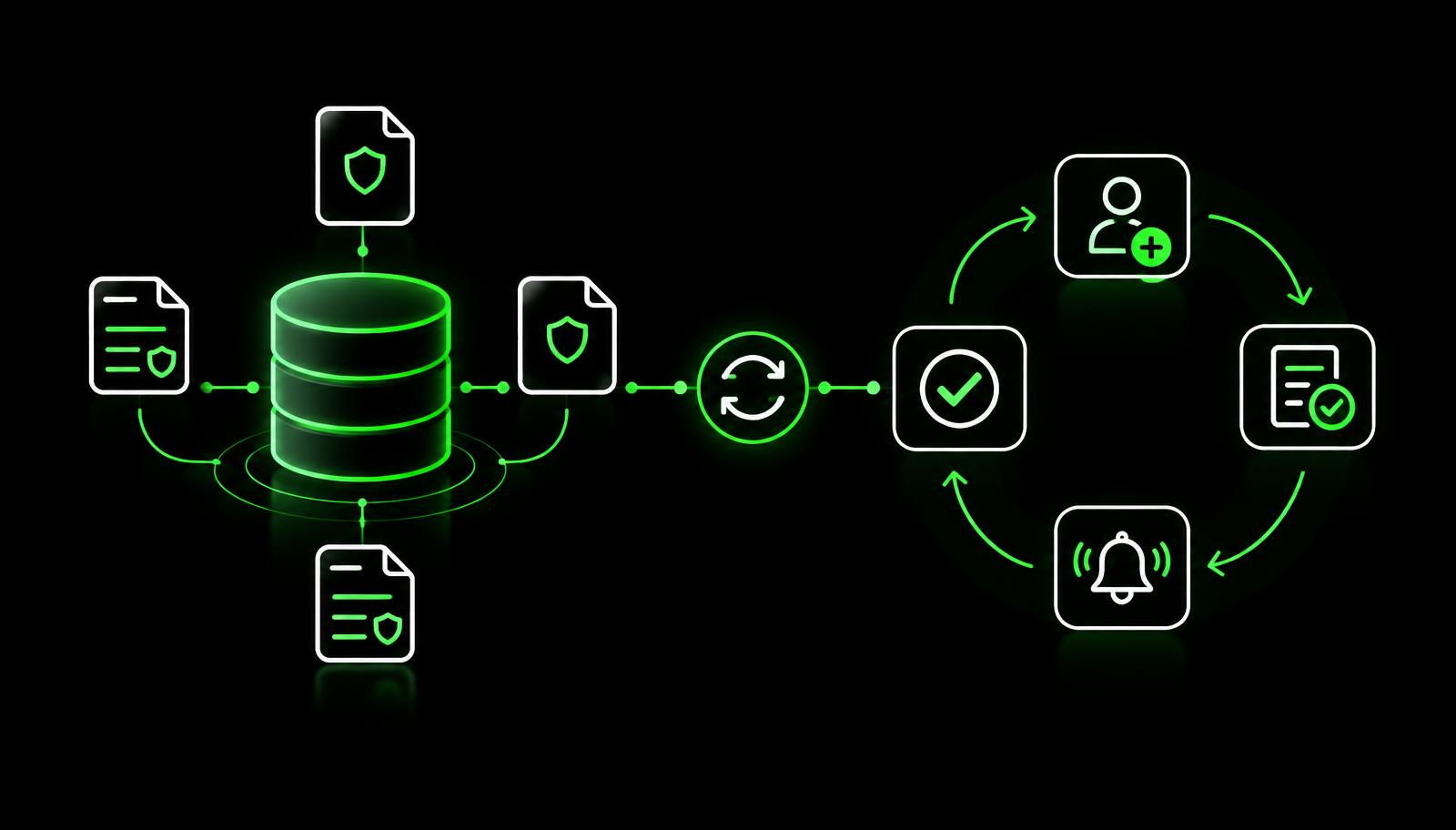
Entitlement, written down before the build starts
System of record
- Authoritative policy, risk and claim data
- Financial truth: reserves, premium, payments
- Contractual terms and coverage
- Regulatory reporting source data
System of action
- Work, tasks and ownership
- Hand-offs, exceptions and escalation
- Evidence, audit trail and approvals
- Operational measurement and SLAs
Most insurance delivery disputes are not really about tooling. They are about authority: which system is allowed to decide, to hold the truth and to be believed when two records disagree.
When that question is left implicit, the workflow layer slowly accumulates copies of policy data, fragments of pricing logic and unofficial financial positions. The result looks like progress for a release or two, then becomes a reconciliation problem that nobody owns. Settling authority early is cheaper than unwinding it later.
System of record versus system of action: the working position
A defensible split is simple to state. The workflow platform owns case state, assignment, service levels, approvals, correspondence, evidence and history. The specialist platforms own policy, claims, finance and reinsurance transactions, together with the product rules and calculations that produce them.
The workflow layer should be authoritative about the work. It should never be authoritative about the money.
Everything else in this paper follows from that sentence: what data may be copied, how interfaces are designed, how failure is handled and who is accountable in production.
Which system owns what: a responsibility matrix
Write this down before the first sprint, review it with the accountable owners and treat any disagreement as a design defect rather than a delivery detail.
| Domain | Authoritative system | Workflow platform responsibility |
|---|---|---|
| Policy and underwriting | Policy administration or underwriting platform | Submission intake, completeness checks, referral routing, authority evidence, decision history. |
| Claims | Claims platform | First notification triage, task plans, expert and supplier coordination, approval routing, communications. |
| Finance | Finance and general ledger systems | Exception cases, evidence, due dates, approval chains, reconciliation follow-up. |
| Reinsurance | Reinsurance administration and finance systems | Recovery and allocation cases, ageing, escalation, dispute and query management. |
| Party and reference data | Master data or reference services | Identifier resolution, referenced context, data-quality exceptions raised back to the owner. |
| Documents and evidence | Document or content service | Requests, receipt tracking, completeness state, linkage to the case and audit trail. |
| Workflow and approvals | Workflow platform | Case model, assignment, service levels, delegated approval routing, complete history. |
| Platform and integration | Shared responsibility | Interface contracts, credentials, monitoring, error handling, reconciliation and support ownership. |
Reference architecture for workflow and core insurance systems
Four boundaries need to be explicit. Channels convert demand into one identifiable case. The workflow layer holds operational context. An integration layer mediates every exchange with authoritative systems. Those systems retain their transactions and calculations.
The important design rule is directional. The workflow layer may read from the core, reference it, or request an authorised transaction. It should not become the place where the core's answer is recomputed.
How to minimise data copied into the workflow platform
Distinguish three categories. Identifiers, such as policy, claim, party or treaty references, should be stored to correlate work. Working context, such as a short description, class of business, jurisdiction or handler note, may be stored because it belongs to the case. Authoritative data, such as premium, coverage, reserves, ledger balances and settlement status, should be referenced at the point of use rather than copied into a parallel store.
Where a value must be displayed inside the case, retrieve it on demand or show it with an explicit source and timestamp. Where a value must be retained for evidence, retain it as a dated snapshot attached to a decision, not as a field that will silently drift from the source.
Which integration pattern to use, and the controls it needs
| Pattern | Use it for | Controls that must exist |
|---|---|---|
| Synchronous API | Immediate reads and authorised transaction requests | Timeouts, idempotency keys, circuit breaking, least-privilege credentials, error mapping. |
| Event or queue | State changes that must propagate reliably without blocking a user | Ordering assumptions, duplicate handling, dead-letter queues, replay procedure. |
| Federated or remote read | Displaying core data without importing it | Access scoping, performance limits, graceful degradation when unavailable. |
| Managed batch | Bulk reconciliation, bordereaux and periodic financial exchange | File contracts, completeness checks, control totals, restart and exception reporting. |
How to design for integration failure
Assume timeouts, duplicates and uncertain write-backs. Every case that initiates a transaction needs a recoverable state: requested, confirmed, failed or unknown. Correlation identifiers should be carried through every hop so that a support engineer can reconstruct what happened without guessing. Where an outcome is uncertain, the safe behaviour is to hold the case for confirmation rather than assume success.
Security, privacy and audit evidence across the boundary
Use managed identities and least-privilege scopes for each interface rather than one shared credential. Classify the data crossing each boundary and record why it needs to cross. Separate administrative access from operational access. Correlate logs across the workflow platform, integration layer and core systems so an audit question can be answered from evidence rather than reconstruction. Set retention explicitly for case records, correspondence and attached evidence, and align it with the retention applied to the authoritative record.
Six questions to settle in the design review
Before development starts, settle the following. Each has a written answer or the design is not ready.
- Which system is authoritative for every material field, rule and transaction in scope?
- What is the minimum case model needed to move the work, and what has been deliberately excluded?
- What is the interface contract for each exchange, including schema, error semantics and ownership?
- What is the threat model for the data crossing each boundary, and which controls address it?
- How does the service behave and recover when a core system or interface is unavailable?
- Who owns the workflow, each integration and the reconciliation in production, by name and by rota?
Where ServiceNow sits as the system of action
ServiceNow is a strong candidate for the system of action. Its case management, role-based workspaces, approval and service-level capabilities map directly to the responsibilities above, and Integration Hub supports API-led integration, reusable spokes and remote tables that expose external data without permanently importing it.
That capability makes the discipline more important, not less. Because the platform can hold almost any data model, the temptation to absorb core insurance data is real. The architectural boundary has to be an explicit decision, documented and enforced in review, rather than a consequence of whatever was convenient in the last sprint.
Impactron's insurance practice works with architecture and delivery teams to set these boundaries, design the integration layer and deliver workflow on ServiceNow without eroding the authority of the systems that hold the insurer's records.
Entitlement by data domain
Systems of record
- Coverage and policy terms
- Reserves and payments
- Premium and ledger entries
- Regulatory submissions
Orchestration layer
- Cases, tasks and ownership
- Approvals and authority checks
- Correspondence and hand-offs
- Operational evidence and audit trail
Measured outcome
- No duplicated source of truth
- Clear accountability per domain
- Integrations that survive change
- Faster delivery of later increments