
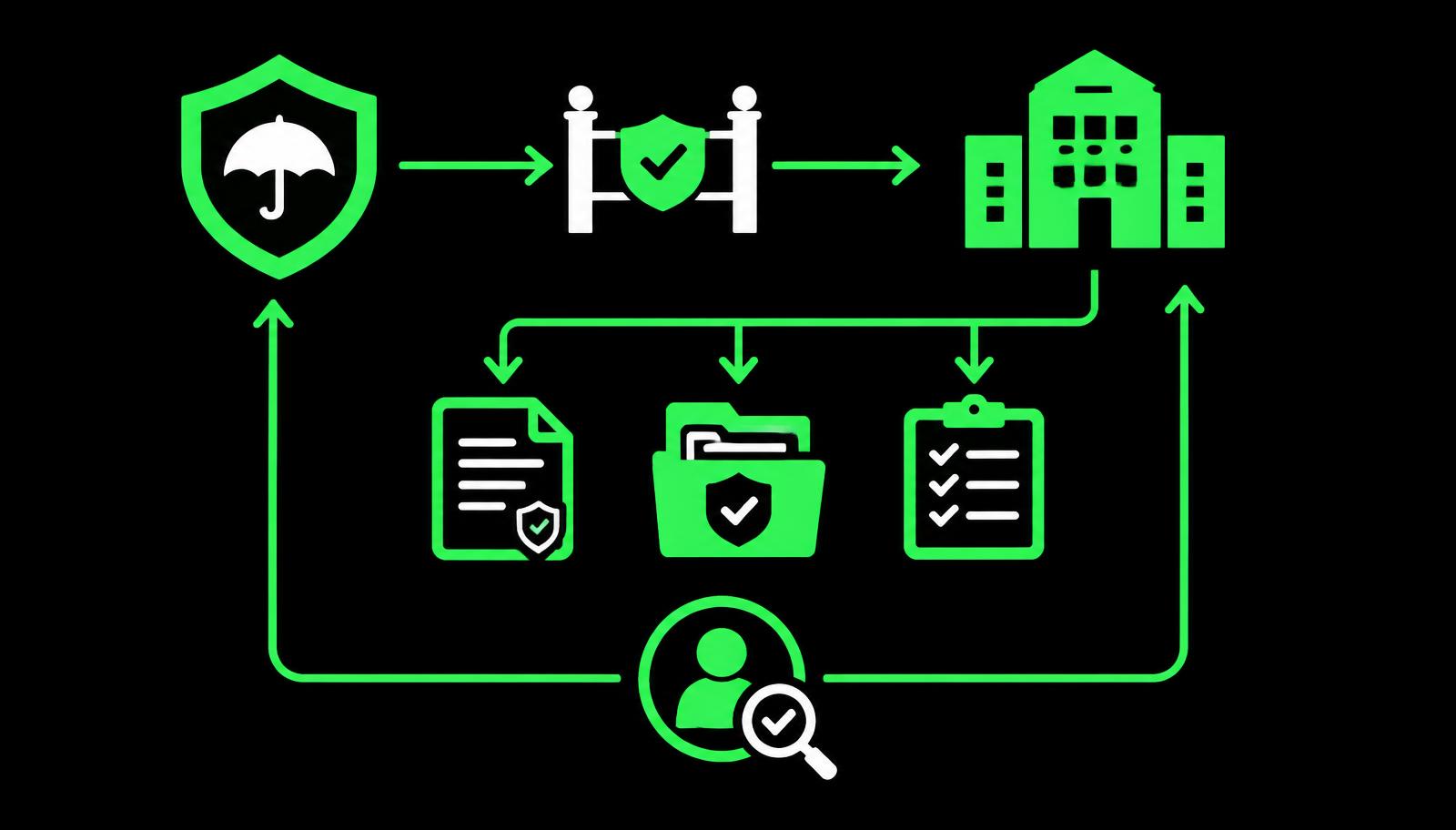
The delegated lifecycle as one tracked obligation set
- 1
Onboarding and due diligence
Checks completed once, recorded properly, and re-usable at renewal.
- 2
Binder and authority terms
Limits and exclusions held as data rather than only in a PDF.
- 3
Bordereaux submission
Expected arrivals tracked, so a missing return is visible the day it is late.
- 4
Data quality validation
Errors returned to the coverholder with a specific reason and a due date.
- 5
Audit
Findings raised against a named owner with an agreed remediation date.
- 6
Remediation to closure
The step that most often ages quietly, and the one boards ask about.
Delegated authority allows insurers and managing agents to expand their reach without building every underwriting, distribution and servicing capability internally. Coverholders provide specialist expertise, local market access, broker relationships and the ability to distribute products at scale. For many insurers, delegated authority is not a peripheral distribution route. It is a central part of the business model.
Delegation does not transfer accountability. The insurer remains responsible for ensuring authority is exercised within agreed parameters, customers are treated fairly, data is reliable, claims are handled appropriately and weaknesses are identified and addressed. The challenge is not whether to exercise control, but how to do so without making the delegated model unworkably slow.
A delegated authority control tower provides a practical answer. It creates one visible lifecycle for onboarding, binder approval, bordereaux monitoring, exception handling, audit and remediation. It lets the business see not only whether an arrangement exists, but how it is performing and where intervention is required.
Delegation moves the work. It does not move the accountability.
How to onboard a coverholder beyond legal eligibility checks
Coverholder onboarding is sometimes treated as a compliance gate: documents are collected, due diligence is completed and the arrangement is approved. In reality, onboarding is the point at which the insurer decides whether a third party has the capability and controls to act on its behalf.
The assessment should consider financial standing, ownership, regulatory status, governance, underwriting expertise, operational resilience, data management, complaints handling, sanctions controls, conduct arrangements and claims capability where relevant. The depth of assessment should be proportionate to the authority being granted and the nature of the business to be written.
A small, tightly controlled delegation with narrow authority is different from a large, multi-territory arrangement with authority to quote, bind, issue policy documentation and manage claims. The control framework should recognise that difference rather than applying identical checks to every relationship.
How binder design turns underwriting strategy into operational control
The binder is where commercial intent becomes operational reality. It defines the scope of authority: what business may be written, where, the product terms that apply, limits and aggregates, referral triggers, exclusions, reporting requirements and any specific conditions.
The quality of binder design has a direct impact on the ability to monitor performance. If authority is described vaguely, it becomes difficult to determine whether the coverholder is operating within it. If data requirements are unclear, bordereaux may not provide the evidence needed for effective oversight.
A strong binder framework translates key terms into operationally testable controls. If a coverholder is not permitted to write a certain occupation, the insurer should be able to identify that occupation in the bordereaux. If claims above a threshold require referral, the workflow should capture whether that referral occurred and whether the approval was recorded.
Not every clause can be reduced to a data field. Insurance contracts contain nuance, and interpretation will sometimes be needed. But the more clearly authority can be represented in the operating process, the earlier an exception can be identified.
How to turn bordereaux data into delegated authority insight
Bordereaux are often received because they are contractually required, but their full value is not always realised. A bordereau can provide evidence of premiums, policies, claims, exposures, cancellations and commissions. It can also reveal whether business is being written within authority and whether trends are developing that require attention.
The practical difficulties are well known. Files arrive late, use inconsistent formats, contain missing fields or need manual reconciliation before they can be analysed. When data quality is poor, teams spend most of their time cleaning information rather than interpreting it.
A control tower should make data quality visible. It should record whether bordereaux arrived on time, whether required fields were complete, whether values reconciled and whether identified exceptions were resolved. That creates accountability and helps distinguish an isolated formatting issue from a persistent weakness in the arrangement.
Monitoring should also be risk-based. Not every data issue warrants the same response. A missing postcode may be a routine correction. A pattern of policies written outside territory or above authority limits may require immediate escalation. The workflow should support that distinction rather than treating all exceptions as equal.
How to give bordereaux exceptions owners and consequences
A control framework is only as strong as its response to exceptions. It is not enough to identify that a policy was written outside authority, a referral was missed or a complaint was not reported on time. The insurer needs to establish what happened, assess the effect, determine who is responsible for remediation and confirm that the corrective action has worked.
Each exception should have a clear classification, severity rating, owner, target date and documented closure evidence. The insurer should also be able to see whether the issue is isolated or recurring. Repeated minor breaches can be more significant than a single serious error, because they may indicate a systemic control weakness.
Consequences should be proportionate. They may range from a request for corrected data or additional training through to enhanced oversight, authority restrictions, formal remediation plans or termination of the arrangement. A good control tower does not assume every problem demands the same response. It makes the response deliberate, recorded and visible.
That approach also supports fair treatment of coverholders. Expectations are transparent, actions are tracked and closure criteria are clear. The relationship becomes more constructive because both parties can see the issue and the agreed route to resolution.
How coverholder audits should drive remediation
Audits are a vital part of delegated authority oversight, but they are most valuable when integrated into ongoing management. An audit should not be an isolated event that produces a report, a list of actions and then little follow-up until the next review.
Audit planning can be informed by operational data. Repeated bordereaux errors, high claims frequency, rapid premium growth, authority breaches, complaints trends, staff turnover or changes in ownership may all indicate that an arrangement requires earlier or deeper scrutiny.
During the audit, findings should connect directly to the relevant control area: underwriting, claims, conduct, data quality, governance or financial management. Afterwards, actions should enter the same remediation workflow used for other material issues, with named owners, deadlines, evidence requirements and escalation if progress stalls.
The key question is not whether an audit finding has been marked as closed. It is whether the insurer has evidence that the underlying control weakness has been corrected and that the correction is operating effectively.
What a delegated authority control tower gives you
Delegated authority often grows quickly because it is commercially effective. New coverholders are appointed, products expand, geographic scope broadens and premium volumes increase. Growth can outpace oversight if the operating model depends on manually maintained trackers and fragmented information.
What a consolidated portfolio view should show senior leaders
This does not remove the need for relationship management or technical expertise. It gives those activities a stronger factual basis. Leaders can focus attention where risk is greatest rather than relying on whichever issue happens to be most visible at the time.
Where to start with delegated authority control
Delegated authority works best when insurers combine commercial confidence with operational discipline. A control tower does not centralise every decision or undermine the expertise of coverholders. It gives the insurer a consistent way to see authority, monitor performance, manage exceptions and prove that concerns have been addressed.
From onboarding to remediation, the objective is the same: scale the business without losing sight of accountability, conduct, regulatory evidence or underwriting control. That is what allows delegated authority to remain a source of sustainable growth rather than an unmanaged concentration of risk.
The delegated lifecycle in one controlled view
Systems of record
- Binder and contract records
- Bordereaux data store
- Policy and premium systems
- Audit reports
Orchestration layer
- Coverholder onboarding and due diligence
- Bordereaux submission and validation
- Audit planning and findings
- Remediation actions with owners
Measured outcome
- On-time bordereaux submission rate
- Data quality exceptions by coverholder
- Overdue audit actions
- Binder compliance evidenced on demand