
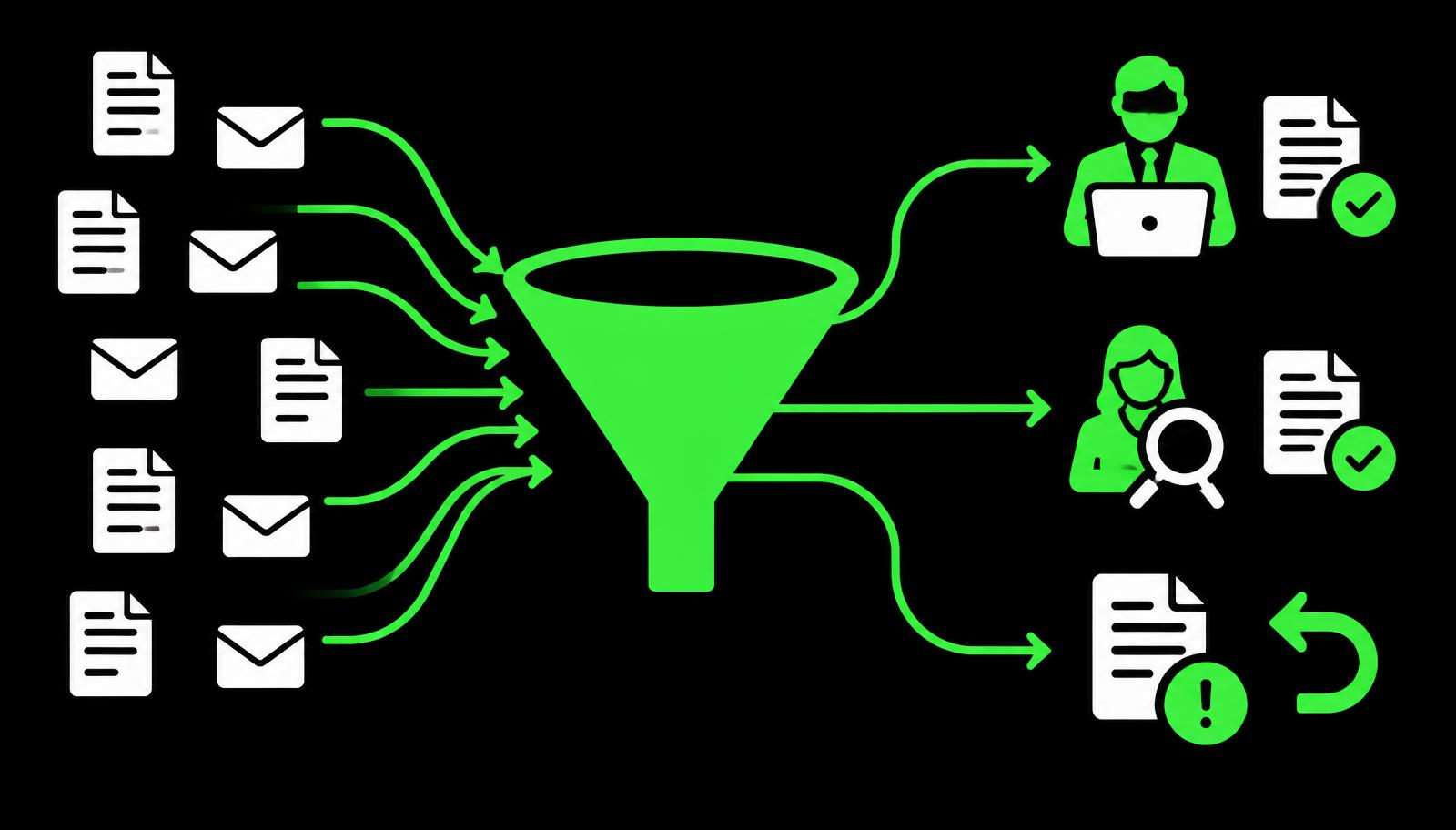
Drawing the triage boundary deliberately
Safe to automate
- Extraction from submission documents
- Completeness and validation checks
- Appetite screening against written rules
- Routing, prioritisation and monitoring
Stays with an authorised underwriter
- Materiality and exposure judgement
- Coverage interpretation and wording
- Commercial and broker relationship context
- Any decision requiring delegated authority
Underwriting automation is often discussed as though the central question is whether technology will replace underwriters. For experienced insurance professionals, that framing is unhelpful. The more relevant question is which parts of the underwriting journey are repetitive, low-risk and suitable for automation, and which involve judgement that should remain clearly owned by an authorised individual.
The answer matters because poor automation design creates a new form of operational risk. If systems accelerate work without recognising complexity, they can produce unsuitable referrals, inconsistent decisions, weak customer outcomes or a false sense that risk has been adequately assessed. If every stage requires manual handling, underwriters lose time to routine activity and the organisation struggles to scale.
A sensible submission-triage model uses technology to prepare, validate, route and monitor work. It reserves human judgement for decisions where uncertainty, materiality, coverage interpretation, commercial context or risk appetite genuinely matter.
Automate the preparation of the decision. Do not automate the decision itself.
What should be automated in submission triage?
The strongest candidates for automation are tasks that are repetitive, rules-based and easily checked. That includes extracting basic data from a submission, identifying missing documents, comparing data fields for inconsistency, recognising a product type and routing the risk to the appropriate team.
A submission-processing tool may recognise the name of an insured, identify the stated turnover, extract requested limits and confirm whether the risk is located in a permitted territory. It can flag when the declared activity does not match the class of business selected, or when a loss-history schedule has not been provided.
These functions are valuable because they reduce administrative effort before the underwriter begins technical analysis. They do not decide whether the risk is acceptable. They help ensure that the underwriter receives a more complete and organised file.
Even apparently simple automation needs appropriate controls. Source documents can be ambiguous. A turnover figure may relate to a group rather than the insured entity. A document may refer to an expiring policy rather than the proposed risk. Technology should show where information came from, flag uncertainty and allow a user to correct the output easily.
How to use triage rules without oversimplifying risk
Rule-based screening is particularly useful for clear underwriting boundaries. An insurer may have explicit restrictions on territory, industry, revenue, limit, attachment point, occupancy type or prior-loss profile. Where those criteria are unambiguous, the workflow can flag a potential appetite issue immediately.
That does not mean the system should automatically decline every submission that triggers a rule. A risk may fall outside normal appetite but be commercially important, supported by exceptional risk controls or appropriate for a senior referral. The system should identify the exception, explain why it has been triggered and route it to an authorised decision-maker.
A mature process therefore uses rules as guardrails. They prevent obvious errors, improve consistency and direct attention to material exceptions. They do not remove the need for professional interpretation.
Which triage decisions should stay with underwriters
Some underwriting decisions are too consequential or too context-dependent to hand to an automated process. These commonly include pricing, coverage terms, acceptance of material exclusions, non-standard endorsements, large or complex lines, declinatures and decisions that materially depart from stated appetite.
Pricing is a good example. A model can provide a technical indication. It can compare exposure against historic loss experience, suggest a rating range or highlight a change in terms from the prior year. But a price is not simply a mathematical output. It reflects aggregation, market conditions, broker strategy, reinsurance structure, capacity management, claims trends and the underwriter's view of risk quality.
Similarly, a coverage decision may turn on the meaning of a contractual obligation, the interaction between policy wording and local law, or a feature of the insured's business that does not fit neatly into a predefined category. These are not failures of automation. They are examples of why underwriting remains a professional discipline.
| Stage | Automate | Keep with an authorised person |
|---|---|---|
| Intake | Data extraction, document checks, completeness validation, provenance capture | Interpretation of ambiguous or conflicting source documents |
| Screening | Territory, industry, limit and prior-loss rules flagged as exceptions | Whether a flagged exception is worth pursuing commercially |
| Allocation | Routing by class, territory, limit, broker and authority level | Deliberate rebalancing during surge or market events |
| Assessment | Assembling exposure, loss history and prior-year comparison | Risk quality, wording, aggregation and appetite judgement |
| Decision | Assembling the referral pack, notifying approvers, tracking status | Pricing, terms, exclusions, declinature and recorded rationale |
How to design meaningful referral and approval gates
Approval gates are where automation and human judgement work together. A workflow can identify that a risk exceeds a threshold, contains a non-standard endorsement, has an adverse claims history or requires a pricing deviation. It can then assemble the relevant information, notify the right approver and track whether a decision has been made.
That is materially better than ad hoc email escalation. The approving underwriter can see the reason for referral, the underlying data, the recommendation made and the evidence supporting it. Their decision is then recorded in a consistent format, including any conditions or limitations.
Approval gates should be proportionate. If every minor variation requires senior sign-off, the process becomes slow and underwriters become reluctant to use it. If thresholds are too broad, material decisions may occur without adequate oversight. The correct balance differs between insurers, classes of business and authority structures.
Reviewing approval data is as important as operating the approval process. A high number of referrals for the same issue may indicate that local authority is too limited, the underwriting rules are unclear or a team requires additional training.
How to use AI in submission triage safely
Artificial intelligence can be useful in triage, particularly for summarising submissions, identifying key clauses, comparing documents, generating question lists and surfacing relevant underwriting guidance. Used well, it reduces the time required to understand a large or poorly structured submission.
The risk arises when AI outputs are treated as though they are decisions. A concise summary can omit an important fact. A suggested classification can be wrong. A recommendation may sound plausible while failing to reflect a technical wording issue or a relevant market development.
AI should therefore be transparent in the workflow. Underwriters should be able to see the source information, identify what the tool has inferred and correct or reject the suggestion. The system should record that a decision was made by an authorised person, rather than presenting an automated recommendation as the final underwriting outcome.
This matters most where decisions affect customer access to cover, pricing, policy terms or claims-related obligations. The insurer must be able to explain what happened, who decided and why.
How to measure triage quality as well as speed
Triage performance should not be measured only by the number of submissions processed or the speed of response. A rapid process that sends unsuitable risks to the wrong team, produces excessive referrals or generates repeated corrections is not efficient in any meaningful sense.
Measures worth tracking together
These measures let leaders improve the workflow without assuming every delay is a problem. Some delays are appropriate because the risk is complex. The aim is not the shortest possible underwriting process. It is the shortest process consistent with sound judgement, proper evidence and accountable decision-making.
What good submission triage looks like in practice
The future of underwriting triage is not fully automated underwriting, and it is not a return to manual inbox management. It is a deliberately designed operating model in which routine preparation is automated, exceptions are surfaced early and consequential decisions remain with skilled, authorised people.
When insurers apply that distinction well, underwriters gain time for the work that creates value: understanding risk, challenging assumptions, negotiating terms and making decisions that are commercially intelligent and technically defensible.
The triage boundary
Systems of record
- Broker submission documents
- Underwriting system
- Appetite and authority rules
- Loss history data
Orchestration layer
- Extraction and field validation
- Completeness and consistency checks
- Appetite screening and routing
- Escalation of uncertainty to a person
Measured outcome
- Higher first-touch completeness
- Consistent routing decisions
- Underwriter time on judgement, not admin
- Auditable record of every automated step