
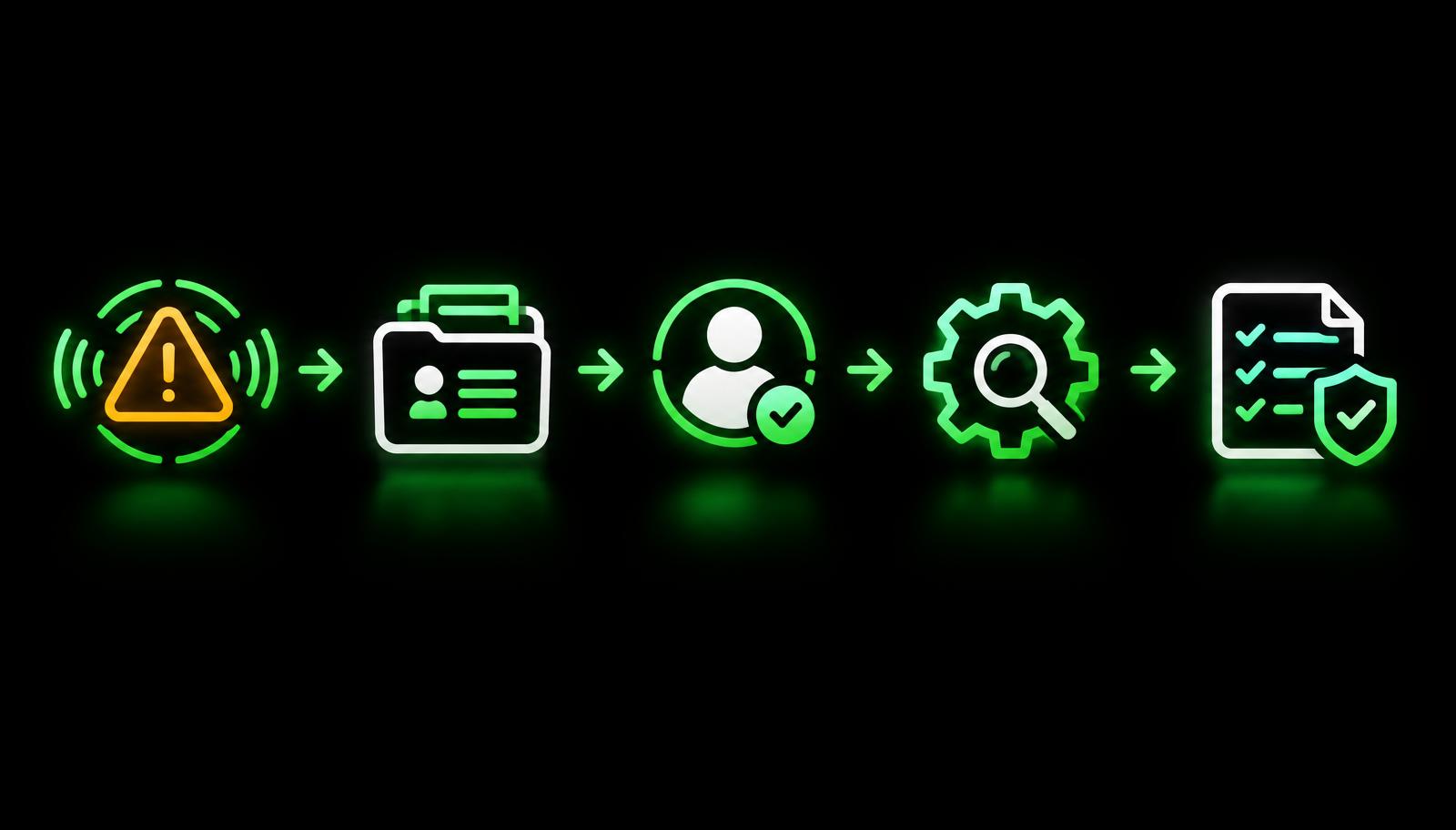
Five things to build before the deadline matters
- 1
One incident taxonomy
A single classification used by technology, operations and compliance.
- 2
A materiality framework
Simple enough to apply consistently at two in the morning.
- 3
Evidence captured live
Timeline recorded as the incident unfolds, not reconstructed afterwards.
- 4
Named ownership per stage
Detection, assessment, notification, resolution and review each have an owner.
- 5
Remediation to closure
Actions tracked with dates, so the board sees the trend rather than a snapshot.
Operational incidents are part of running an insurance business. Systems fail, suppliers experience disruption, data becomes unavailable, cyber events occur, processes break down and human error creates unexpected consequences. What differentiates a resilient insurer is not the belief that incidents can be eliminated. It is the ability to identify them early, understand their impact, maintain evidence, make accountable decisions and drive effective remediation.
As expectations around operational incident reporting become more structured, insurers should avoid treating the issue as a narrow compliance exercise. A reporting form, however well completed, is only the final expression of a much broader capability. If the insurer cannot reliably identify an incident, assess its significance, coordinate its response and preserve the evidence behind its decisions, regulatory reporting will remain difficult and potentially unreliable.
The right question is not "can we submit a report?" It is "can we demonstrate that we understand, govern and learn from disruption across our business?"
How should insurers define a reportable operational incident?
Many incidents begin as ordinary operational issues. A customer portal becomes unavailable. A batch process fails. A third-party service provider misses a deadline. A payment file contains an error. At first the event appears local and manageable. Later it may become clear that customers have been affected, data has been compromised, service standards have been breached or a critical business service has been disrupted.
This is why a common incident taxonomy matters. Employees across technology, operations, claims, underwriting, finance, customer service, risk and compliance need practical guidance on what should be logged and escalated. If each area uses its own definitions, the insurer may classify similar events differently, or fail to connect related issues altogether.
A good taxonomy is usable rather than academic. It should explain the difference between a routine service issue, a near miss, an operational incident, a material incident and a crisis-level event. It should also allow the classification to evolve as more information becomes available.
That matters because early reporting decisions are made under uncertainty. The process should support responsible escalation without penalising teams for raising an issue before every fact is known.
How to assess incident materiality beyond elapsed time
Duration matters, but it is not the only measure of severity. A brief failure in a critical payment or claims process could have significant customer impact. A longer outage in a non-critical internal system may be inconvenient but not materially disruptive. The assessment needs to reflect the actual consequences of the event.
Factors an effective materiality framework should consider
These factors should not become a complicated scoring exercise that slows down response. Their value lies in helping teams ask the right questions consistently. The assessment record should show the evidence available at the time, the judgement reached and the reason for that judgement.
How to capture incident evidence while the incident unfolds
During an incident, teams are understandably focused on restoring service and protecting customers. If evidence is not captured as the event unfolds, it can be very difficult to reconstruct what happened later.
Relevant evidence may include system logs, service-desk records, customer contacts, supplier communications, impact assessments, incident-call notes, decisions made, approvals obtained, workaround instructions and remediation actions. Different teams hold different parts of that record, and the information quickly becomes fragmented.
A controlled incident workflow provides a shared case record. It does not require every operational detail to be copied manually into one place, but it should show where evidence is held, who has reviewed it and how the assessment has changed over time.
That supports accurate regulatory reporting, enables internal review, assists with audit and reduces the risk that an important decision is later impossible to explain. It also supports fair accountability by showing what was known at the time rather than judging earlier decisions solely with the benefit of hindsight.
Who owns each stage of incident reporting
Incident management involves different roles. A person who identifies a problem may not be qualified to assess its regulatory significance. A technology lead may coordinate restoration but not own customer communications. A compliance function may review a report but not have responsibility for fixing the underlying cause.
Confusion about those roles leads to delayed escalation, duplicated work or gaps in ownership. A well-designed workflow should distinguish clearly between the incident owner, business-service owner, technical resolver, risk and compliance reviewer, communications lead, reporting approver and accountable executive.
This is not about adding hierarchy at a stressful moment. It is about ensuring the right decisions are made by the right people, and that nobody assumes someone else is managing a critical task.
How to make FCA incident reporting controlled and repeatable
Where an incident requires regulatory notification or other formal reporting, the organisation should be able to produce a coherent account of the event without starting from a blank page. The report should draw on the underlying incident record, including timing, impact, actions taken, governance decisions and planned remediation.
Approval is a key safeguard. Reports should have clearly defined review and sign-off steps, with version control so the insurer can show what was submitted, when and who approved it. That matters particularly where incident facts change over time and subsequent updates are required.
The reporting process should be tested before a serious event occurs. Tabletop exercises reveal whether teams know their responsibilities, whether evidence is readily available and whether the organisation can produce clear, timely communications under pressure. Testing should include third-party scenarios, because many significant operational incidents involve suppliers, cloud services, outsourced administrators or other external dependencies.
How remediation proves operational resilience
Restoring a service is not the same as resolving the incident. A system may come back online while the root cause remains unclear. A workaround may protect customers temporarily but be labour-intensive and unsuitable for future use. A supplier may provide assurance, yet the insurer may still need to test whether promised changes have been implemented.
Effective remediation should address immediate containment, root cause, control improvement and verification. Actions should be prioritised according to the severity of the incident, recurrence risk, customer impact and relevance to important business services.
Leaders should be able to see which remediation actions are overdue, which require investment, which depend on third parties and which have been closed without sufficient evidence. That visibility prevents the common problem of incidents being declared resolved because the immediate crisis has passed, even though the underlying vulnerability remains.
Over time, incident data should inform resilience planning. Repeated incidents involving the same process, supplier, application or control may point to a broader structural weakness. The insurer can then use real operational evidence to prioritise investment and improve its ability to remain within impact tolerances during disruption.
Where ServiceNow fits in operational incident reporting
Most insurers already hold parts of this capability in ServiceNow. Incident and major incident management, the service model, change records and third-party data usually live there, which makes it a practical place to run the reporting chain rather than building a separate compliance tool alongside it.
In practice that means linking each incident to the important business services it affects, capturing the materiality assessment against agreed thresholds, timestamping detection, assessment and notification, routing regulatory reporting through named approvers and tracking remediation as work with owners and due dates. Because the service map, application and supplier records sit on the same platform, the dependency view comes from live configuration data rather than a document refreshed once a year.
The platform does not create the capability on its own. An inaccurate service map or an untested plan will produce confident reports about the wrong things. The value appears when accountable owners use the same records in exercises, live events and board reporting, so the evidence a regulator asks for is a by-product of how the firm already works.
What insurers should build before the 2027 rules apply
Preparing for more structured operational incident reporting is not primarily about compliance documentation. It is about building a dependable organisational capability: one that identifies disruption quickly, assesses materiality consistently, preserves evidence, assigns clear ownership and follows through on remediation.
For insurers, that capability strengthens more than regulatory readiness. It supports better customer outcomes during disruption, stronger board assurance, more effective third-party oversight and a more realistic understanding of operational resilience. Firms that build it now will be better prepared not only to report incidents, but to manage them with confidence when they occur.
Incident reporting as a by-product of the workflow
Systems of record
- Monitoring and alerting tools
- Service and dependency map
- Regulatory reporting submissions
- Risk register
Orchestration layer
- Single incident taxonomy
- Materiality assessment and sign-off
- Live timeline and evidence capture
- Remediation actions to closure
Measured outcome
- Faster mobilisation and classification
- Reports produced without reconstruction
- Overdue actions visible to the board
- Impact tolerances tested, not assumed