
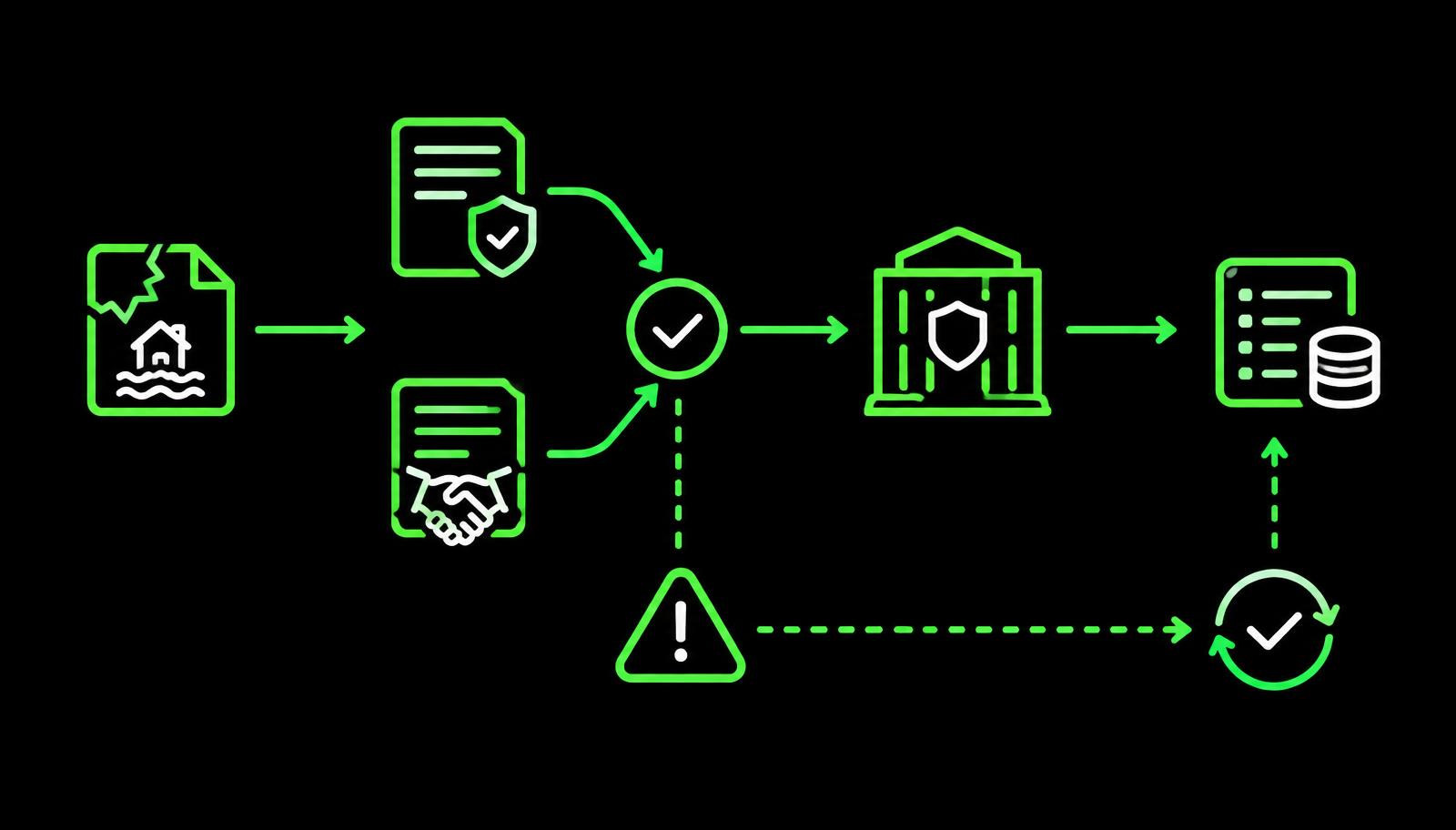
The recovery pipeline, made visible
- 1
Recovery identified
Triggered from the claim rather than discovered later during reconciliation.
- 2
Evidence assembled
Contract wording, loss detail and calculations gathered against a checklist.
- 3
Ownership agreed
The ambiguity between claims and finance resolved in the workflow, once.
- 4
Presented to reinsurers
Submission recorded with a date, so ageing starts from something real.
- 5
Queries and chasing
Responses tracked, with the chase sequence owned rather than remembered.
- 6
Cash collected
Finance forecasts from a live pipeline instead of reconstructing a position.
For an insurer, a reinsurance recovery is more than an accounting entry. It represents money the insurer expects to collect after it has paid, or committed to pay, its own policyholder. Until that money arrives, the insurer is carrying the cash-flow burden.
This is why outstanding recoveries become a working-capital issue. The insurer may have correctly recognised a reinsurance asset, notified the relevant reinsurer and completed its internal calculations, but if collection is delayed the expected cash remains unavailable. At scale, that affects liquidity management, capital planning, financial forecasting and the relationship between finance, claims and ceded reinsurance teams.
The underlying causes are usually operational rather than contractual. Missing evidence, inconsistent figures, unresolved queries, unclear ownership and incomplete follow-up leave recoveries ageing for months. The answer is not more chasing. It is better visibility of the recovery lifecycle and a clear process for moving cases towards collection.
The useful question is not whether the balance is correct. It is what is preventing this recovery from becoming cash, and who will resolve it.
Why reinsurance recoveries create a working-capital gap
The policyholder expects the claim to be handled and paid in accordance with the policy terms. The insurer cannot normally wait for reinsurers to settle before meeting that obligation, so it pays the gross claim first and recovers the reinsurers' share afterwards.
In a straightforward case the gap is short. The loss is notified, the claim is agreed, the reinsurer receives the supporting information and payment follows. In complex, high-value or long-tail claims the process is far less direct. Reserves change, multiple layers respond, loss allocations are revised and questions arise over attachment, aggregation, coverage or the timing of notifications.
The financial consequence is cumulative. One delayed recovery is manageable. Hundreds or thousands of outstanding balances, especially after a catastrophe, reserving development or large-loss event, become a substantial source of pressure on working capital.
For that reason, reinsurance recovery performance belongs alongside collections, payables and liquidity forecasting. It is not simply a back-office measure of reconciliation efficiency.
Why reinsurance recoveries age: the common causes
Not all aged recoveries are the same, and treating them as a single category makes management harder. A recovery may be outstanding because the insurer has not yet submitted the full evidence package. It may be awaiting a reinsurer's response, subject to a legitimate coverage query, disputed, or agreed but not yet paid.
| Reason outstanding | Required action | Accountable specialism |
|---|---|---|
| Evidence package incomplete | Document collection and validation | Claims and reinsurance operations |
| Awaiting reinsurer review | Monitoring against expected response time | Ceded reinsurance |
| Coverage or allocation query | Technical analysis and response | Reinsurance and claims specialists |
| Disputed balance | Legal, actuarial or senior commercial involvement | Legal and commercial leadership |
| Agreed but unpaid | Settlement follow-up and confirmation of details | Finance |
A five million pound recovery submitted two weeks ago and awaiting normal review may be less urgent than a five hundred thousand pound recovery unresolved for eighteen months with no clear owner. Value matters, but duration, uncertainty and inactivity matter too.
How evidence quality drives recovery collectability
Reinsurers need sufficient evidence to validate a recovery. Depending on the treaty or facultative arrangement, that may include claim notifications, bordereaux, payment records, adjuster reports, policy wording, loss calculations, reserve movements, legal advice and evidence of coverage decisions.
When that information is dispersed across claims files, finance systems, email inboxes and local folders, the recovery process slows. Different teams hold different versions of the same data. A reinsurer's query then triggers a lengthy internal search rather than a quick response.
A structured recovery case provides one controlled location for the relevant evidence and correspondence. That does not require every document to be copied into one system, but the workflow should make clear where the authoritative evidence sits and whether it has been reviewed.
Evidence quality also affects relationships. Reinsurers process recoveries more efficiently when submissions are complete, consistent and supported by a clear audit trail. Repeated incomplete or inconsistent submissions lead to more scrutiny, more queries and slower cash collection.
Who should own reinsurance recovery collection
Recoveries sit at the intersection of several functions. Claims teams understand the underlying loss. Ceded reinsurance teams understand treaty terms and recoverability. Finance manages cash, accounting and reconciliations. Legal, actuarial and underwriting teams become involved where a matter is complex.
That cross-functional structure is necessary, but it creates ambiguity. Everyone contributes information while no one owns the next action. A claims handler may believe reinsurance has submitted the recovery. The reinsurance team may be waiting for updated payment data. Finance may see an overdue receivable but lack the operational context to challenge it effectively.
Clear ownership does not mean one person must solve every issue. It means each recovery should have a named case owner responsible for moving it forward, obtaining input from the right specialists and escalating when progress stalls. The workflow should show that ownership visibly, along with deadlines and action history.
Senior escalation should be based on defined triggers: value, age, inactivity, dispute status, financial reporting significance or potential relationship impact. That prevents material cases from remaining unresolved simply because they are complex.
How to measure reinsurance recovery performance
A recovery dashboard should go beyond a list of balances. It should help management understand how efficiently expected reinsurance cash becomes collected cash.
Measures worth reporting together
How case management shortens recovery cycles
When recoveries are handled primarily through reconciliations and spreadsheets, the conversation focuses on whether a balance is correct. That is necessary but incomplete.
A case-management approach makes the more useful question visible. Each recovery can be tracked through identification, evidence gathering, submission, query management, agreement, payment and closure, with supporting documents, tasks, correspondence and approvals held in the case history.
That gives finance and reinsurance operations a shared operating view. Finance can see the cash and balance-sheet significance of delayed recoveries. Reinsurance specialists can see the practical actions required to resolve them. Claims teams can understand how changes in the underlying claim affect collectability.
The result is not simply better administration. It is a more disciplined approach to managing a material financial asset.
Where ServiceNow fits in reinsurance recovery operations
Where a firm already runs ServiceNow, the recovery case is a natural fit for the platform. Each recovery can be modelled as a case with a defined lifecycle, linked to the underlying claim reference, carrying the evidence pack, the tasks needed to complete it, the due dates agreed with the reinsurer or broker and the approvals required before submission. Ageing, escalation and reminders then run from the same record rather than from a spreadsheet maintained alongside it.
Integration Hub can pull claim movements, cession data and settlement postings from the claims, reinsurance and finance systems so the case reflects current values without recreating the calculations. Reporting can then answer the questions finance actually asks: what is outstanding, how old is it, who owns it, what is blocking it and what has been recovered in the period.
The boundary matters as much as the build. Treaty interpretation, cession calculation and accounting remain in the specialist systems. ServiceNow carries the operational work around them. Firms that keep that line clear get a recovery capability that improves cash collection without adding a second version of the financial truth.
Where to start on reinsurance recovery performance
Reinsurance recoveries become a working-capital problem when expected cash remains locked in unresolved operational activity. The issue is rarely solved by chasing harder at month-end. It requires complete evidence, clear ownership, structured escalation and an ageing view that explains why balances remain outstanding.
Insurers that manage recoveries as active cases rather than passive receivables improve cash collection, strengthen reinsurer relationships and give finance leaders a more reliable view of liquidity. In a market where capital discipline matters, that is a meaningful operational advantage.
The recovery pipeline made visible
Systems of record
- Treaty and contract records
- Claims platform
- Finance and ledger
- Reinsurer correspondence
Orchestration layer
- Recovery case with a named owner
- Evidence checklist and chasing
- Exception and query handling
- Reconciliation break resolution
Measured outcome
- Reduced overdue recoveries
- Shorter time to complete evidence
- Fewer reconciliation breaks
- Recovery ageing visible to finance weekly